
A burn may heal, yet the scar can keep changing for months. Post-burn keloid treatment focuses on reducing a scar that has grown beyond the original injury, easing symptoms such as itching or pain, and improving appearance or movement. The right plan depends on the scar type, location, size, symptoms, and any previous treatment.
Post-Burn Keloid Treatment: What Patients Should Know
Post-burn keloid treatment often uses more than one method. Steroid injections, silicone-based care, cryotherapy, laser treatment, pressure therapy, and surgery with added treatment may all have roles. The best choice depends on whether the scar is truly a keloid, its size and location, symptoms, and previous recurrence.
Evidence from hypertrophic burn scars should not automatically be applied to true keloids. PRP is also being investigated, but its role remains uncertain.
What Is a Post-Burn Keloid?
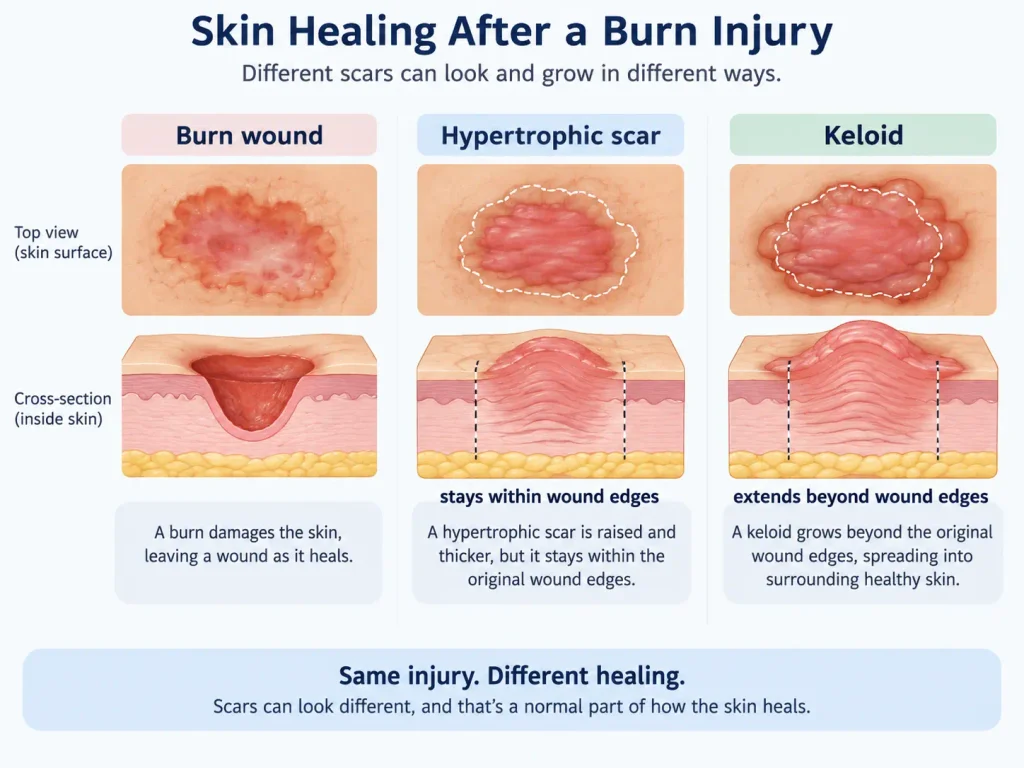
A keloid is a raised scar that grows beyond the edges of the original wound. It forms when wound healing produces excessive scar tissue. Keloids can also itch, hurt, feel firm, or create cosmetic and functional concerns, as described in the background to Alharbi and Zafar’s 2025 scar-treatment review.
Burn patients can also develop hypertrophic scars, another type of raised scar. The distinction matters because treatment evidence is not identical, so diagnosis should come before treatment.
Good wound care also matters early in recovery. The European Burns Association guideline emphasises wound closure, infection prevention, patient comfort, and dressing choices based on the wound’s cause, depth, location, drainage, and contamination.
Why Do Keloids Form After Burns?
A burn triggers a normal repair process involving inflammation, new tissue formation, and later remodelling. In a keloid, this process becomes excessive and scar tissue grows into the surrounding skin. Genetics, injury characteristics, scar location, and the way the wound heals may all influence the final scar.
Limandjaja and colleagues’ review of keloid biology describes the interacting biological processes behind this abnormal response.
This is why post-burn keloid treatment is rarely a simple “remove it and forget it” process. Treatment may reduce thickness, symptoms, or size without guaranteeing permanent removal.
Post-Burn Keloid Treatment Options
Treatments work in different ways and may be used alone or together. The international scar-management review by Gold and colleagues found that clinical and cosmetic outcomes may improve when treatments are combined.
| Treatment | How it may help | Often considered for | Main limitation |
|---|---|---|---|
| Steroid injections | May flatten scar tissue and ease symptoms | Diagnosed keloids | Skin thinning, visible small blood vessels, and pigment changes |
| Silicone | Maintains hydration and is used in scar care | Hypertrophic scars and selected keloid-care plans | Evidence for treating established keloids is uncertain |
| Pressure therapy | Applies sustained compression | Hypertrophic burn scars and selected postoperative keloids | Benefit remains uncertain; prolonged use can be demanding |
| Cryotherapy | Freezes scar tissue to reduce its volume | Selected, often smaller keloids | Pain, healing time, repeated treatment, and pigment changes |
| Laser treatment | May improve selected scar features | Selected burn scars, hypertrophic scars, or keloids | Evidence and effects vary by scar type and laser |
| Surgery with added therapy | Removes tissue while additional treatment addresses recurrence | Selected keloids considered for surgery | Recurrence remains possible |
| PRP | Investigated for improving scar outcomes | Research and selected clinical settings | Not established specifically for post-burn keloids |
1. Steroid Injections
Intralesional corticosteroids are injected directly into the scar and are a long-established treatment for keloids.
The international scar-management review describes intralesional corticosteroids as a first-line option for keloids and notes that they may be combined with other treatments. Reported local side effects include skin thinning, visible small blood vessels, and loss of pigment.
For post-burn keloid treatment, steroid injections may therefore be considered when a clinician confirms that the raised burn scar is a keloid.
2. Silicone Gel and Sheets
Silicone gel or silicone sheets are widely used in scar care. The evidence reviewed by Gold and colleagues supports their use in scar management, particularly for hypertrophic scars, although some studies were vulnerable to bias.
The European Burns Association guideline also lists silicone within burn-scar management and describes consensus support for gel sheets in the prevention and treatment of hypertrophic scars.
However, a 2023 Cochrane review found very low-certainty evidence for treating established keloids with silicone sheets. Their use should therefore be discussed with realistic expectations. Apply them only to healed skin, following clinical advice and product instructions.
3. Pressure Therapy
Pressure garments are a long-standing part of burn rehabilitation, especially for hypertrophic scars, but the evidence remains uncertain.
The 2014 scar-management review noted no change in overall scar scores and only a small improvement in scar height in the meta-analysis it cited. More recently, a 2024 Cochrane review of pressure garments after burns found insufficient evidence to determine whether they are more effective than alternative approaches for preventing hypertrophic scarring.
Garments should be fitted and reviewed by the treating team. Evidence concerning burn garments should also be distinguished from the use of pressure earrings after ear-keloid surgery.
4. Does Cryotherapy Work for Post-Burn Keloids?
Cryotherapy freezes scar tissue and can reduce selected keloids, but it is not a guaranteed cure.
The review by Gold and colleagues describes studies reporting reductions in scar volume and improvements in hardness, elevation, redness, itching, pain, and tenderness. Limitations include repeated treatment, pain, healing time, skin thinning, and pigment changes, which may be permanent.
Cryotherapy may also be combined with steroid injections for some small keloids. These findings concern selected keloids generally rather than establishing a predictable response specifically for post-burn keloids.
5. Laser Treatment
The international scar-management review includes laser treatment for hypertrophic scars and keloids. It also reports improvements in clinical and structural features of burn scars after fractional CO₂ laser treatment.
Temporary redness, swelling, and bruising-like spots called purpura were among the reported side effects. However, the 2022 Cochrane laser review found insufficient evidence to establish the overall effectiveness of laser therapy for hypertrophic and keloid scars.
Because the evidence covers different scar types and laser approaches, laser treatment should be matched to the diagnosed scar rather than viewed as a single generic “laser scar removal” procedure.
6. Is Surgery Effective?
Surgery can remove a keloid, but recurrence remains an important concern. The reviewed evidence supports planning additional treatment rather than treating excision as the complete strategy.
The scar-management review by Gold and colleagues describes reduced recurrence with approaches such as corticosteroid treatment or, in selected adult cases, postoperative radiotherapy.
That does not mean every post-burn keloid needs surgery or radiotherapy. Treatment decisions should be individualised.
7. Where Does PRP Fit in Post-Burn Keloid Treatment?
Platelet-rich plasma, or PRP, is an emerging approach rather than a proven standard treatment for mature keloids.
The 2025 meta-analysis by Alharbi and Zafar included 11 randomised controlled trials with 539 participants, including four burn-scar studies and two keloid studies. Pooled data did not show a statistically significant improvement in clinician-rated scar outcomes at three months. Patient-reported outcomes improved at six months, but the studies varied substantially in PRP preparation, treatment methods, and scar types.
Because the pooled analysis included postoperative scars, burn scars, and keloids, the six-month result should not be interpreted as proof that PRP works specifically for post-burn keloids.
The authors also state that the effectiveness of PRP in burns remains uncertain and that its use in keloids has largely been based on empirical evidence.
More high-quality, long-term studies are needed, particularly for mature or fibrotic—dense, stiff—scars.
Do Keloid Removal Creams or Home Remedies Work?
The reviewed sources do not establish that a home remedy can reliably flatten or permanently remove an established keloid.
The international scar-management review specifically describes limitations and mixed evidence for onion-extract products. Some trials reported improvements in scar symptoms or appearance, while another comparison found onion extract no more effective than a petrolatum-based moisturiser.
That is different from evidence showing that a cream can permanently remove a true keloid.
When Should You See a Dermatologist or Burn-Scar Specialist?
Professional assessment is useful when a scar is growing beyond the original burn, is painful or very itchy, limits movement, keeps returning after treatment, or when you are unsure whether it is a keloid or a hypertrophic scar.
A specialist can help define whether the main goal is symptom control, flattening, improved movement, appearance, recurrence prevention, or several goals at once. These outcomes are related, but they are not identical.
Practical Patient Checklist
Before discussing treatment, write down:
- When the burn happened and how long it took to heal.
- When the scar began to thicken or grow beyond the original injury.
- Whether you have itching, pain, tightness, or restricted movement.
- Any previous steroid injections, silicone, pressure garments, lasers, cryotherapy, surgery, or wound care.
- Whether the scar returned after earlier treatment.
- Your main goal: less pain, less itching, a flatter scar, better movement, improved appearance, or lower recurrence risk.
Useful questions include: “Is this definitely a keloid?”, “What result is realistic?”, “What are the side effects?”, and “How will we reduce the chance of recurrence?”
Read Also / See Related
- Chest keloid after a burn — Explore how tension across the chest can affect scar management and treatment planning.
- Newly formed keloid scars — Learn why early assessment matters when a healed burn begins developing a raised, growing scar.
- Keloid removal — Understand the difference between removing scar tissue and preventing it from returning.
Conclusion
Post-burn keloid treatment is usually about reducing or controlling a scar rather than promising a permanent cure. Steroid injections, silicone-based scar care, pressure therapy, cryotherapy, lasers, and surgery with added treatment can each have a role depending on the type of scar and the treatment goal.
PRP is being studied, but the available evidence does not establish it as a proven treatment specifically for post-burn keloids.
The next step is a professional assessment based on the scar itself, previous treatment, recurrence history, and your goals. Book a consultation to discuss your options, or explore our guide to keloid scar treatment.
References
- Alharbi Z, Zafar T. The efficiency of platelet-rich plasma (PRP) in treating post-burn and surgical scars: a meta-analysis study. Journal of Clinical Medicine. 2025;14(23):8490. doi: 10.3390/jcm14238490.
- European Burns Association. European Practice Guidelines for Burn Care: Minimum Level of Burn Care Provision in Europe. Version 4. 2017. Available at: European Practice Guidelines for Burn Care.
- Limandjaja GC, Niessen FB, Scheper RJ, Gibbs S. The keloid disorder: heterogeneity, histopathology, mechanisms and models. Frontiers in Cell and Developmental Biology. 2020;8:360. Available at: https://pmc.ncbi.nlm.nih.gov/articles/PMC7264387/.
- Gold MH, Berman B, Clementoni MT, Gauglitz GG, Nahai F, Murcia C. Updated international clinical recommendations on scar management: Part 1—Evaluating the evidence. Dermatologic Surgery. 2014;40(8):817–824. doi: 10.1111/dsu.0000000000000049.
- Tian F, Jiang Q, Chen J, Liu Z. Silicone gel sheeting for treating keloid scars. Cochrane Database of Systematic Reviews. 2023;1. doi: 10.1002/14651858.CD013878.pub2.
- Harris IM, Lee KC, Deeks JJ, Moore DJ, Moiemen NS, Dretzke J. Pressure-garment therapy for preventing hypertrophic scarring after burn injury. Cochrane Database of Systematic Reviews. 2024;1. doi: 10.1002/14651858.CD013530.pub2.
- Leszczynski R, da Silva CAP, Pinto ACPN, Kuczynski U, da Silva EMK. Laser therapy for treating hypertrophic and keloid scars. Cochrane Database of Systematic Reviews. 2022;9. doi: 10.1002/14651858.CD011642.pub2.
Medical disclaimer
The information in this article is provided for general educational purposes and does not replace professional medical advice, diagnosis, or treatment. Consult a dermatologist or another qualified healthcare professional about your symptoms and treatment options. Do not disregard professional medical advice or delay seeking care because of information you have read on KeloidCare.org. Responses to keloid treatments vary, and individual results cannot be guaranteed.