
Cryotherapy for keloids uses extreme cold to damage abnormal scar tissue and may help reduce a scar’s size and firmness. It is one of several treatment options available, but results vary, and neither complete removal nor permanent freedom from recurrence can be guaranteed.
Keloids extend beyond the boundaries of the original skin injury and may cause itching, tenderness, and other keloid symptoms. Choosing treatment involves considering these symptoms alongside appearance, skin tone, previous treatment, and the practical demands of recovery.
What Is Cryotherapy for Keloids?
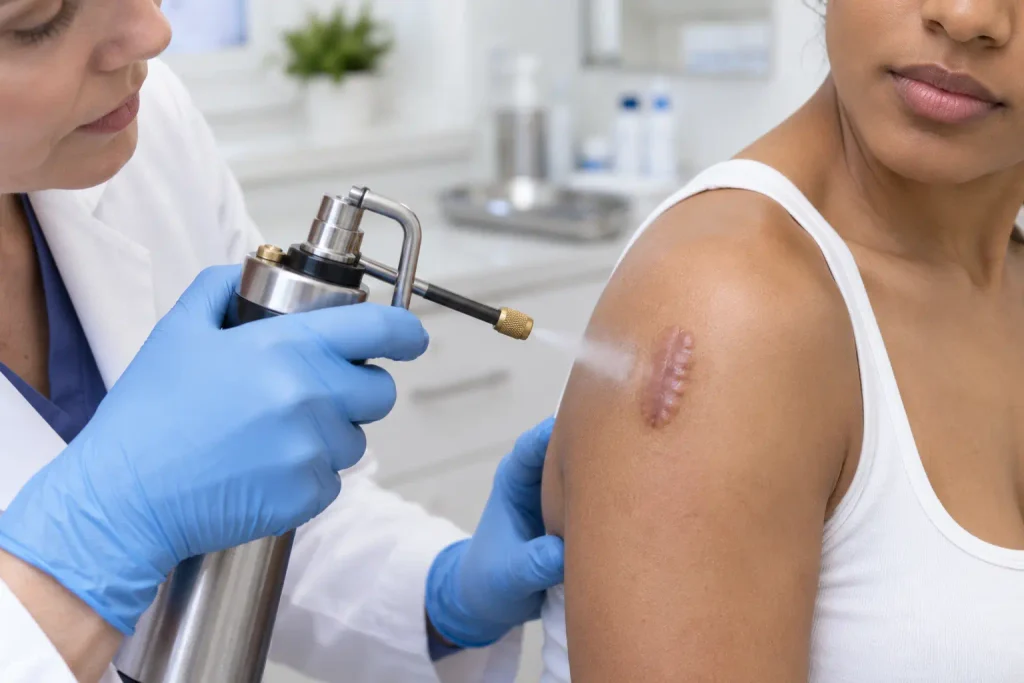
Cryotherapy, also called cryosurgery, freezes targeted tissue. Two approaches are used in scar treatment:
- Surface cryotherapy: Cold is applied from outside the scar, typically using a liquid nitrogen spray or a contact probe.
- Intralesional cryotherapy: A specialized needle-like probe is placed through the scar, allowing it to freeze from within.
These techniques should not be described as interchangeable. Intralesional treatment penetrates the scar and usually involves local anesthesia; it is therefore more accurately described as minimally invasive than non-invasive. A review by O’Boyle and colleagues explains the technique and its practical considerations.
Who May Benefit From Treatment?
The American Academy of Dermatology identifies smaller keloids as particularly suitable for cryosurgery. However, suitability also depends on the treatment technique and the individual scar.
Before recommending treatment, a dermatologist should assess the scar and discuss the likelihood of benefit against the risk of pigment changes. This is especially important for people with darker skin, because a treated area can become permanently lighter.
For a wider overview of available approaches, see our guide to keloid scar treatment.
What Happens During the Procedure?
The exact procedure depends on whether the clinician uses surface or intralesional freezing.
1. Assessment and Treatment Planning
The clinician examines the scar, reviews previous treatments, and discusses the intended outcome. Useful goals might include reducing bulk or improving comfort rather than expecting the skin to look exactly as it did before the injury.
2. Preparation and Pain Control
The treatment area is prepared, and pain control is selected for the planned technique. Brief surface freezing may not require injected anesthesia, whereas intralesional treatment generally does.
3. Controlled Freezing
For surface treatment, the clinician applies the freezing agent to the outside of the scar. For intralesional treatment, the probe freezes tissue from within. Appointment length varies with the technique, scar size, and number of areas treated.
4. Wound Care and Follow-Up
Before leaving, patients should receive instructions for wound care, pain relief, and review. Intralesional treatment may require several weeks of healing, so a short appointment should not be confused with a short recovery. O’Boyle et al.
How Effective Is Cryotherapy for Keloids?
Research reports improvements in scar size and symptoms, but the evidence does not support one success rate for every patient or technique.
A systematic review by Walsh and colleagues describes promising outcomes with cryotherapy while highlighting variation between studies. Differences in scar characteristics, treatment schedules, and follow-up make direct comparisons difficult.
A separate review by Limmer and Glass reports that intralesional treatment performed better than spray treatment in some studies, while repeated sessions were often necessary. These findings do not establish that one technique is always preferable.
When discussing cryotherapy for keloids, ask what outcome is realistic for your scar, how improvement will be measured, and when the treatment plan will be reviewed. Flattening is not the same as permanent removal, and recurrence remains possible.
Combining Cryotherapy With Other Treatments
Cryotherapy may be used alongside corticosteroid injections for keloids. Combination treatment can be considered when a single approach does not provide sufficient improvement, although the choice and timing should be individualized.
Other options include laser treatment for keloid scars or surgery with an appropriate plan to address recurrence. The Walsh review discusses these approaches and the limitations of the supporting research.
Silicone gel for keloids may also be discussed as part of ongoing scar care. Silicone products should not be applied over an open treatment wound; wait until the skin has healed and your clinician confirms that they are appropriate. American Academy of Dermatology
Possible Side Effects
Potential side effects include:
- Pain or tenderness during and after treatment.
- Swelling and blistering.
- Lightening or darkening of the treated skin.
- Delayed healing or infection.
- Less commonly, additional scarring or temporary numbness.
Pigment changes are not always temporary. Both surface and intralesional treatment require a discussion of this risk, particularly when appearance is the main reason for seeking care. Reviews also document recurrence after initial improvement. British Association of Dermatologists; Limmer and Glass
Managing Pain and Caring for the Treated Area
Follow the instructions given for your particular procedure. General advice for a small area of surface freezing may not be sufficient after intralesional treatment.
Paracetamol, also called acetaminophen, may help with discomfort if it is suitable for you. Ask your clinician or pharmacist about appropriate pain relief.
General care may include gentle cleansing, petroleum jelly if recommended, and a dressing where clothing could rub the area. Avoid picking scabs or puncturing blisters without medical advice. Contact the treating clinic if pain increases or pus develops, as these can indicate infection. The British Association of Dermatologists’ cryotherapy leaflet provides general aftercare guidance.
Questions to Ask Before Treatment
A consultation is an opportunity to clarify both the expected benefit and the practical commitment:
- Which freezing technique are you recommending, and why?
- What is the pigment-change risk for my skin?
- How many appointments might be needed?
- Will I need dressings or changes to daily activities?
- What happens if the scar returns or does not improve?
If comparing costs, ask whether the estimate includes anesthesia, dressings, follow-up, and possible repeat sessions. A single-session price may not reflect the full course of care.
Frequently Asked Questions
Is Cryotherapy a Permanent Cure?
No permanent cure can be promised. A keloid may improve and later regrow, so follow-up remains important.
How Many Sessions Will I Need?
Removal cannot be guaranteed. Evidence for treating established keloids is uncertain, and an older scar may need assessment for other options. Agree on realistic treatment goals with your dermatologist.
Is Treatment Suitable for Darker Skin?
It may be considered, but the possibility of lasting pigment loss requires particular attention. Discuss whether another treatment would offer a more acceptable balance of benefits and risks. American Academy of Dermatology
Can I Freeze a Keloid at Home?
Do not attempt to reproduce a clinical procedure with home freezing products. Arrange an assessment to confirm the diagnosis and discuss treatment designed for the scar.
Choosing the Next Step
Cryotherapy for keloids can be a useful option for selected patients, including as part of combination treatment. The decision should account for likely improvement, pigment changes, healing time, and recurrence. A consultation can help establish a realistic plan that reflects your symptoms and priorities.
Read Also / See Related
- Keloid steroid injections — Learn about an injection treatment that may be combined with cryotherapy.
- Keloids on the ear — Explore treatment considerations for ear keloids, including scar size, location, and recurrence.
- Laser for keloid scars — Understand another procedure your clinician may discuss, including its evidence, risks, and recovery requirements.
References
- O’Boyle CP, Shayan-Arani H, Hamada MW. Intralesional cryotherapy for hypertrophic scars and keloids: a review. Scars, Burns & Healing. 2017;3:2059513117702162. doi: 10.1177/2059513117702162.
- American Academy of Dermatology Association. Keloid scars: Diagnosis and treatment. Available at: https://www.aad.org/public/diseases/a-z/keloids-treatment.
- Walsh LA, Wu E, Pontes D, et al. Keloid treatments: an evidence-based systematic review of recent advances. Systematic Reviews. 2023;12:42. doi: 10.1186/s13643-023-02192-7.
- Limmer EE, Glass DA II. A review of current keloid management: mainstay monotherapies and emerging approaches. Dermatology and Therapy. 2020;10:931–948. doi: 10.1007/s13555-020-00427-2.
- British Association of Dermatologists. Cryotherapy. Patient information leaflet. Updated October 2022. Available at: https://www.bad.org.uk/pils/cryotherapy.
Medical disclaimer
The information in this article is provided for general educational purposes and does not replace professional medical advice, diagnosis, or treatment. Consult a dermatologist or another qualified healthcare professional about your symptoms and treatment options. Do not disregard professional medical advice or delay seeking care because of information you have read on KeloidCare.org. Responses to keloid treatments vary, and individual results cannot be guaranteed.
[…] Cryotherapy […]
[…] Cryotherapy […]