
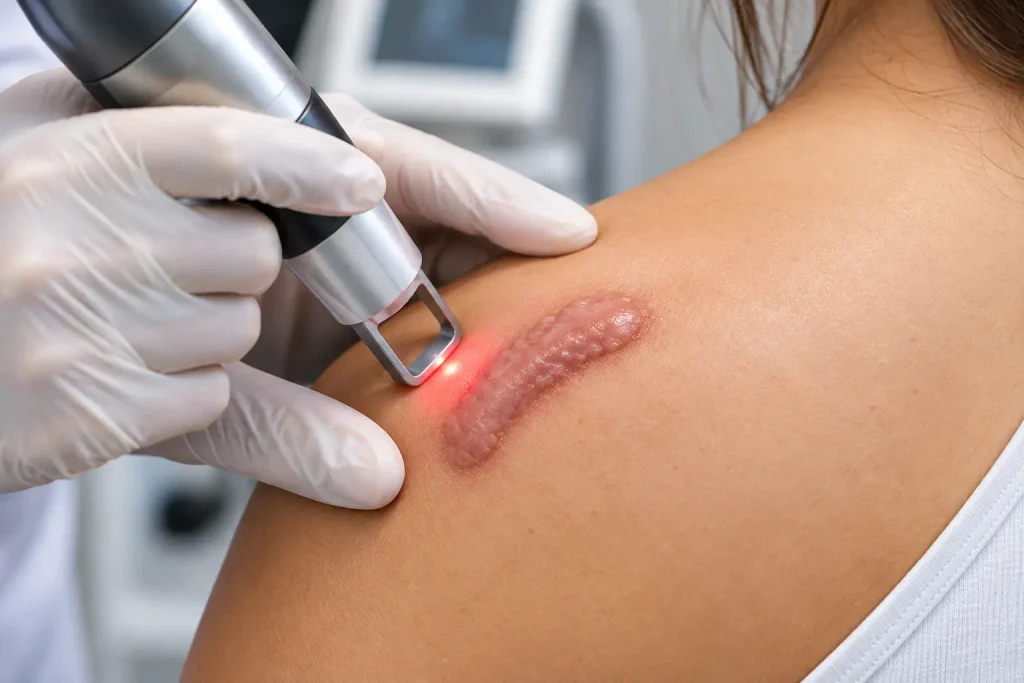
Laser for keloid scars may help improve selected features such as redness, texture, and scar firmness. However, treatment does not guarantee complete removal, and keloids can return after an initial improvement.
Keloids develop when excessive scar tissue grows beyond the boundaries of a skin injury. They may follow acne, surgery, burns, or piercings and can cause itching or discomfort. Choosing treatment requires an assessment of the scar, your skin tone, previous treatment, and the outcome you hope to achieve.
How Does Laser Treatment Work?
Different lasers target different structures. Vascular lasers act on blood vessels, while fractional ablative lasers create microscopic treatment channels in the skin. These approaches should not be described as having the same mechanism.
The international scar-management recommendations by Gold et al. discuss vascular and fractional lasers within a broader treatment framework. Their review covers several scar types, so findings for burn scars or surgical scars cannot automatically be applied to keloids.
For an overview of other approaches, see our keloid scar treatment guide.
How Effective Is Laser for Keloid Scars?
Some studies report improvement, but the certainty of the evidence remains limited.
The 2022 Cochrane review by Leszczynski et al. found low-certainty evidence that 585-nm pulsed-dye laser may improve hypertrophic and keloid scars compared with no treatment. Evidence for fractional CO₂ laser and several combination treatments was very uncertain.
The review did not establish that lasers consistently outperform other treatments or that combining laser with injections always produces better results. Some studies also included both hypertrophic scars and keloids, which makes interpretation more difficult.
When considering laser for keloid scars, agree on specific goals with your clinician. Reduced redness, improved flexibility, or symptom relief may be more realistic than complete disappearance.
Which Laser Is Best for Keloids?
There is no universally best laser. Selection depends on the scar’s characteristics, skin pigmentation, treatment risks, and the clinician’s experience.
Pulsed-Dye Laser
Pulsed-dye laser, or PDL, targets hemoglobin in blood vessels. It may be considered when redness and vascularity are prominent features.
The scar-management recommendations by Gold and colleagues discuss PDL as an option for raised scars. Changes in other scar characteristics have also been reported, but results vary. PDL should not be presented as a guaranteed method for flattening every thick keloid.
Fractional CO₂ Laser
Fractional CO₂ laser targets water in tissue and creates microscopic columns of ablation, leaving intervening areas untreated. The aim is controlled remodeling rather than simply stimulating more collagen.
As described in Walsh and colleagues’ systematic review of keloid treatments, fractional ablative lasers may also be used to assist the delivery of prescribed medicines into scar tissue. This is a clinician-directed procedure, not a reason to apply steroid creams yourself after laser treatment.
Nd Laser
The 1064-nm Nd laser has been studied for keloids, including in combination with corticosteroid injections. Its longer wavelength allows deeper penetration than PDL, but depth alone does not establish that it is better for a particular scar.
Ekstein and colleagues’ review of keloid management discusses Nd among the available laser approaches. Its use should not be explained simply as “stimulating collagen production.” The treatment goal is to modify abnormal scar tissue, and clinical results depend on the device settings and treatment plan.
Combining Laser With Other Treatments
Laser therapy may form one part of a treatment plan that also includes:
- Keloid steroid injections: Used to reduce inflammation and excessive scar-tissue activity.
- 5-Fluorouracil injections: Considered in selected cases, sometimes alongside corticosteroids.
- Silicone gel or sheets: Used as part of scar care once the treated skin has healed and the clinician approves.
- Other procedures: Options such as cryotherapy may be discussed when another approach better matches the scar.
Ekstein et al. and Walsh et al. describe combination approaches while highlighting variation in treatment response. The purpose and timing of each treatment should be clear.
What Happens During Treatment?
The consultation should include a review of your medical history, previous scarring, medicines, and any history of cold sores. The clinician examines the scar and explains the proposed laser, pain-control options, and recovery requirements.
During treatment, protective eyewear is used. The sensation and appointment length depend on the device, settings, and area treated. Several appointments may be proposed, with progress reviewed before continuing.
Ask which aspects of your keloid symptoms the procedure is intended to improve and how those changes will be measured.
Risks and Skin-Tone Considerations
Possible adverse effects include redness, swelling, discomfort, bruising, crusting, and changes in skin pigmentation. Infection, delayed healing, and additional scarring can also occur.
Ramsdell’s review of fractional CO₂ complications emphasizes careful patient selection, appropriate settings, and early recognition of complications. It discusses resurfacing safety generally rather than providing a keloid-specific complication rate.
Similarly, Graber et al. found that darker skin phototypes were more susceptible to post-inflammatory hyperpigmentation after a particular nonablative fractional treatment. That study involved mixed treatment indications and does not establish the risk for every keloid laser procedure.
People with darker skin can still be considered for treatment, but device selection and pigment-related risks deserve an explicit discussion.
Recovery and Aftercare
Recovery time depends on the laser type, treatment settings, and the area treated. Your clinician should explain what to expect and provide aftercare instructions tailored to the procedure.
Follow the recommended cleansing, dressing, and skin-care routine. Avoid picking crusts or applying products that your clinician has not approved. Protect the treated area from sun exposure as directed, and ask when you can restart your usual skin-care products.
As discussed in Ramsdell’s review of fractional CO₂ laser complications, appropriate aftercare and early recognition of infection are important for healing. Contact the treating clinic if pain worsens, discharge develops, or the area is not healing as expected.
Cost of Laser Keloid Treatment
There is no reliable universal price for laser keloid treatment. Cost depends on the country, clinic, laser type, treatment area, and number of appointments.
Ask for an estimate that explains whether consultation, anesthesia, aftercare, follow-up, and combination treatments are included. A per-session price does not necessarily represent the total cost.
Choosing a Treatment Plan
Laser for keloid scars may be useful when selected for a specific purpose and integrated into an appropriate plan. The decision should balance potential improvement with recovery time, pigment changes, cost, and recurrence.
Book a consultation to confirm the diagnosis and discuss realistic treatment goals before committing to a course of laser therapy.
Read Also / See Related
- Keloid steroid injections — Learn about an injection treatment that may be considered alongside laser therapy.
- Red scar healing — Explore changes in scar redness and when persistent colour changes deserve assessment.
- Keloid vs. hypertrophic scar — Understand why identifying the scar type matters when interpreting laser treatment results.
References
- Mony M.P., et al. (2023). An Updated Review of Hypertrophic Scarring.
- Gold MH, Berman B, Clementoni MT, Gauglitz GG, Nahai F, Murcia C. Updated international clinical recommendations on scar management: Part 1—Evaluating the evidence. Dermatologic Surgery. 2014;40(8):817–824. doi: 10.1111/dsu.0000000000000049.
- Leszczynski R, da Silva CAP, Pinto ACPN, Kuczynski U, da Silva EMK. Laser therapy for treating hypertrophic and keloid scars. Cochrane Database of Systematic Reviews. 2022;9. doi: 10.1002/14651858.CD011642.pub2.
- Walsh LA, Wu E, Pontes D, et al. Keloid treatments: an evidence-based systematic review of recent advances. Systematic Reviews. 2023;12:42. doi: 10.1186/s13643-023-02192-7.
- Ekstein SF, Wyles SP, Moran SL, Meves A. Keloids: a review of therapeutic management. International Journal of Dermatology. 2021;60(6):661–671. doi: 10.1111/ijd.15159.
- Ramsdell WM. Fractional CO₂ laser resurfacing complications. Seminars in Plastic Surgery. 2012;26(3):137–140. doi: 10.1055/s-0032-1329415.
- Graber EM, Tanzi EL, Alster TS. Side effects and complications of fractional laser photothermolysis: experience with 961 treatments. Dermatologic Surgery. 2008;34(3):301–305; discussion 305–307. doi: 10.1111/j.1524-4725.2007.34062.x.
- Further Reading
- The following clinic articles provide general patient information and are separate from the scientific references above.
- Santé Clinics. Laser Treatment for Keloid Scars: A Comprehensive Guide. Available at: Santé Clinics patient guide.
- Dr Sajjas. How to Get Rid of Keloids via Laser Treatment? Available at: Dr Sajjas patient guide.
- The following clinic articles provide general patient information and are separate from the scientific references above.
Medical disclaimer
The information in this article is provided for general educational purposes and does not replace professional medical advice, diagnosis, or treatment. Consult a dermatologist or another qualified healthcare professional about your symptoms and treatment options. Do not disregard professional medical advice or delay seeking care because of information you have read on KeloidCare.org. Responses to keloid treatments vary, and individual results cannot be guaranteed.
[…] Laser treatment may be considered to improve selected scar features, including redness, texture, or thickness. Different lasers have different purposes, and they are often used alongside other treatments. […]
[…] Laser Treatment […]