

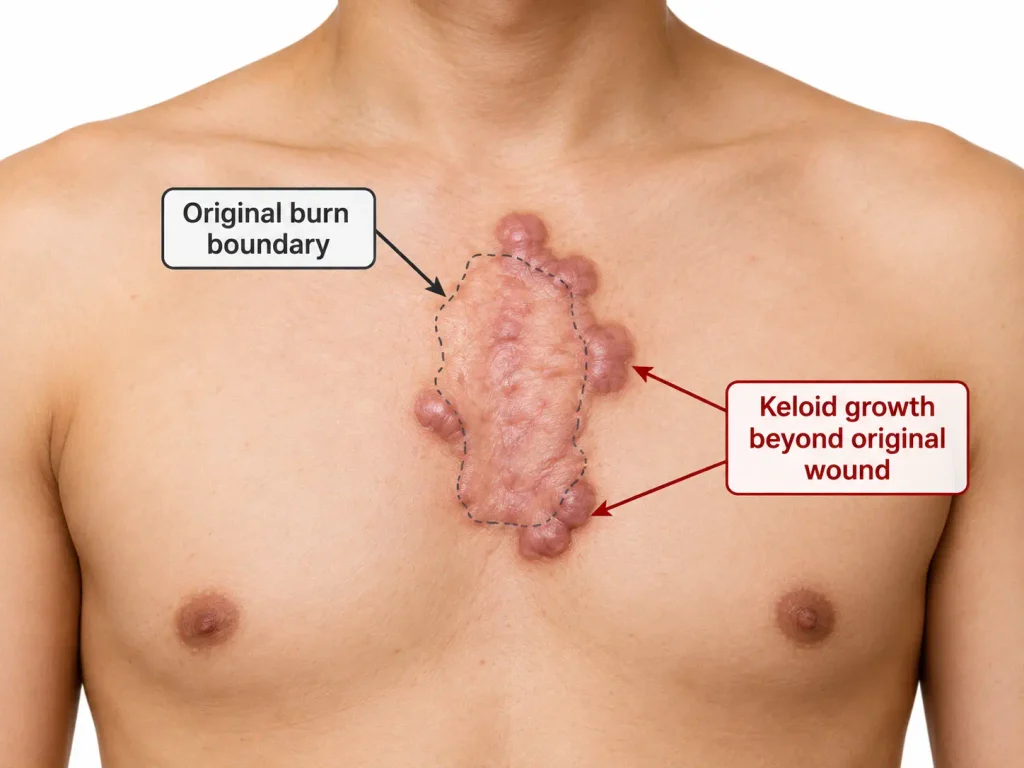
A Chest Keloid can appear after a burn has healed, sometimes months after the original injury. Instead of staying within the damaged area, the scar continues growing beyond the original wound. It may become firm, raised, itchy, tender, or uncomfortable.
The chest can be a difficult area for keloids because the skin is exposed to repeated stretching and tension. Treatment can improve symptoms, size, thickness, or appearance, but no approach can promise permanent removal.
Quick Answer
A Chest Keloid can form after a burn when scar tissue grows beyond the original wound. The chest is a high-tension area, which may make recurrence more challenging. Treatment may include steroid injections, silicone, cryotherapy, laser, or surgery combined with other therapies, depending on the scar.
What Is a Chest Keloid After a Burn?
A keloid is a raised scar that grows beyond the borders of the original injury. By comparison, a hypertrophic scar is raised but usually remains within the original wound boundaries. Keloids also have little tendency to disappear spontaneously. [4]
That distinction matters after a burn. Burns commonly produce hypertrophic scars, but a true keloid behaves differently and may need a different treatment plan.
A chest-specific study also confirms that burns can lead to chest keloids. In a group of 58 patients treated for chest keloids, 10 cases — 17.2% of that particular treatment cohort — followed burns. This figure should not be interpreted as the overall prevalence of burn-related keloids. [1]
Why Can Burns Lead to Chest Wall Keloids?
A burn causes skin trauma and starts a complex wound-healing process. In abnormal scar formation, fibroblasts — the cells that help build scar tissue — can produce excessive collagen and other structural proteins. [4]
The chest adds another factor: mechanical tension.
Chest skin stretches with normal movement, posture, and breathing. The chest-keloid study by Park and colleagues linked stretching tension with keloid formation and noted that the chest is a high-tension site. [1]
This may partly explain why chest wall keloids can be persistent and why recurrence remains an important consideration after treatment.
Not every thick burn scar is a keloid. Burn injuries frequently cause hypertrophic scarring, so identifying the scar type before treatment is important.
What Does a Chest Keloid Look and Feel Like?
A Chest Keloid is usually firm and raised. The key clinical feature is that it grows outside the borders of the original burn wound. Keloids can also be symptomatic. [4]
You may notice:
- A thick or raised scar.
- Scar tissue spreading beyond the original burn.
- Firmness or stiffness.
- Itching.
- Tenderness.
- Pain or sensitivity.
- A noticeable colour difference from nearby skin.
An itchy keloid scar can be particularly frustrating because clothing and movement across the chest may repeatedly irritate the area.
Symptoms alone cannot confirm that a scar is a keloid. A clinician may need to distinguish it from a hypertrophic burn scar or another skin condition before recommending treatment.
Keloid or Hypertrophic Burn Scar?
The two conditions can look similar, but they are not interchangeable.
| Feature | Keloid | Hypertrophic burn scar |
|---|---|---|
| Growth pattern | Extends beyond the original wound | Usually stays within the wound |
| Shape | Raised and often firm | Raised and often firm or stiff |
| Natural course | Little tendency to regress spontaneously | May gradually improve or flatten |
| Burn relationship | Burns can trigger true keloids | Common form of abnormal burn scarring |
| Treatment evidence | Keloid-specific evidence is needed | Much burn-scar research relates specifically to hypertrophic scars |
The distinction is especially important when reading about laser therapy, silicone, pressure garments, or rehabilitation. Evidence showing that a treatment improves a hypertrophic burn scar does not automatically prove the same benefit for a true keloid. [4]
Do Chest Keloids Go Away or Come Back?
True keloids are unlikely to disappear completely without treatment. Unlike hypertrophic scars, they have a low tendency toward spontaneous regression. [4]
They can also return after treatment.
This is particularly important with keloid removal by surgery. Removing the tissue creates another skin injury, and surgery alone has historically been associated with substantial recurrence. The chest-specific study therefore used surgical excision together with steroid injections rather than relying on excision alone. [1]
Keloid removal is therefore not the same thing as a permanent cure. In many cases, the goal is to flatten the lesion, improve symptoms and appearance, and reduce the chance of regrowth.
Treatment Options for a Chest Keloid
There is no single treatment that works equally well for every keloid. Scar size, symptoms, location, previous recurrence, skin characteristics, and previous treatments all influence the plan.
Combination treatment is common because several approaches target different parts of the scarring process. An international scar-management review found that clinical and aesthetic outcomes often appeared better with combined approaches than with single treatments. [2]
| Treatment | How it may help | Often considered for | Main limitation |
|---|---|---|---|
| Steroid injections | May flatten and soften keloid tissue | Raised or symptomatic keloids | Response varies; skin changes can occur |
| Silicone gel/sheets | Supports scar management | Healed scars and adjunct treatment | Requires consistent use; does not remove a keloid |
| Cryotherapy | Can reduce scar volume and symptoms | Selected, often smaller keloids | Pain and pigment changes can occur |
| Laser therapy | May improve colour, texture or symptoms | Selected scars, especially hypertrophic burn scars | Keloid-specific evidence is less certain |
| Surgery + adjunct therapy | Physically removes bulky scar tissue | Large or resistant keloids | Recurrence remains possible |
| Pressure/rehabilitation | Used in burn-scar management | Mainly hypertrophic burn scars | Evidence is mixed and chest application can be difficult |
| PRP | Emerging scar treatment | Investigational or selected settings | Evidence for established keloids remains limited |
Steroid Injections
Intralesional corticosteroids are medicines injected directly into scar tissue. A major scar-management review described them as a preferred first-line treatment for keloids and noted that they can also be combined with other therapies. [2]
They may help reduce thickness and symptoms, but results vary. Possible local effects include skin thinning, small visible blood vessels, and lighter pigmentation. [2]
You can read more about steroid injections for keloids.
Silicone Gel or Silicone Sheets
Silicone-based products are widely used in scar care. Evidence reviewed by Gold and colleagues supports their role particularly in the prevention and management of hypertrophic scars, including burn scars. [2]
That evidence should not be interpreted as proof that silicone permanently removes an established Chest Keloid. It may instead be used as part of a broader scar-management plan.
Cryotherapy
Cryotherapy freezes scar tissue. Evidence reviewed in the international recommendations reported reductions in scar volume and improvements in symptoms such as itching, pain, tenderness, and elevation in some studies. [2]
Traditional cryotherapy may require repeated sessions. Pain, slower healing, skin atrophy, and pigment changes are possible limitations. Intralesional cryotherapy — freezing the scar from inside — has also been studied.
See our guide to cryotherapy for keloid scars.
Laser Treatment
Laser therapy may target redness, thickness, texture, stiffness, or symptoms. Fractional CO₂ and pulsed-dye lasers are among the approaches studied in pathological and burn scars.
However, this is an area where scar type matters. A review found promising results for hypertrophic and burn scars but concluded that the overall level of evidence for laser treatment across hypertrophic scars, keloids, and burns remained limited. [4]
This means results from hypertrophic burn scars should not automatically be applied to true chest keloids.
Surgery and Combination Treatment
Surgery may be considered when a keloid is large, bulky, resistant to other treatments, or particularly troublesome.
The main limitation is recurrence. In a chest-specific series, 58 patients underwent excision combined with intraoperative and postoperative steroid injections rather than surgery alone. [1]
That study supports the rationale for combination treatment, but it was an observational cohort rather than a modern randomized trial. Treatment decisions should therefore be individualized.
Pressure Therapy and Burn Rehabilitation
Pressure therapy is commonly used for hypertrophic burn scar management, although the European Burns Association notes that evidence is conflicting. Silicone, massage, and laser treatment are also used in burn rehabilitation. [3]
Pressure is also harder to apply consistently over some areas of the chest. [1]
This is another example of why treatment for a hypertrophic burn scar should not automatically be treated as established therapy for a true keloid.
What About PRP?
Platelet-rich plasma, or PRP, is being studied as a scar treatment, but it should still be viewed cautiously for established chest keloids.
A 2025 meta-analysis included 11 randomized controlled trials with 539 participants, but only two studies focused on keloids. Pooled results did not show a significant improvement in scar appearance at three months, although patient-reported scores improved at six months. The studies also differed substantially in scar type and PRP protocols. [5]
The authors concluded that PRP’s role in chronic or fibrotic scars such as keloids remains less well defined. [5]
Do Keloid Removal Creams or Home Remedies Work?
There is no evidence in the reviewed sources that an over-the-counter keloid removal cream or home remedy can reliably eliminate an established true keloid.
Some topical products are used for scar management, but that is different from removing a keloid.
For example, silicone gel has evidence in scar management, particularly for hypertrophic scars. Other topical preparations have produced mixed results in clinical studies. [2]
Be cautious with products advertised as permanently dissolving or removing keloids. A treatment that moisturises or softens a scar is not necessarily changing the biological process that causes a keloid to grow.
When Should You See a Dermatologist?
Professional assessment is useful when a scar continues growing beyond the original burn, causes persistent symptoms, or when you are unsure whether it is a keloid.
Consider an assessment if:
- The scar is expanding outside the original burn area.
- Itching, pain, or tenderness is persistent.
- The scar is becoming thicker or more raised.
- Previous treatment was followed by regrowth.
- You are considering surgery or another procedure.
- The diagnosis between a keloid and hypertrophic scar is unclear.
A clinician can assess the scar’s location, size, symptoms, history, and previous treatments before discussing realistic treatment goals.
Practical Patient Checklist
Before your appointment:
- Think about when the scar started growing. Note whether growth continued after the burn had fully healed.
- Take older photographs if you have them. They can help show changes in size or shape.
- List previous treatments. Include silicone, injections, laser, surgery, creams, or home treatments.
- Describe your main concern. Is it itching, pain, thickness, appearance, movement, or recurrence?
- Ask what the treatment is expected to achieve. Clarify whether the goal is flattening, symptom relief, improved appearance, or physical removal.
- Ask about recurrence. This is especially important if surgery is being considered.
Read Also / See Related
- Why is my scar getting bigger? — Learn what changes in scar size may mean and when continued growth deserves a clinical assessment.
- Post-burn keloid treatment — Explore treatment options and evidence limitations for keloids that develop after burns.
- Keloid vs. hypertrophic scar — Understand why a raised chest scar is not always a keloid and how the distinction affects treatment.
Conclusion
A Chest Keloid after a burn is different from an ordinary burn scar. A true keloid grows beyond the original wound, and tension across the chest may make treatment and recurrence more challenging.
Steroid injections, cryotherapy, silicone, laser therapy, and surgery combined with other treatments may all have a role, but they do not have the same level of evidence for every scar type. Burn-related hypertrophic scar research should not automatically be applied to true keloids.
The most useful treatment plan depends on what the scar is, how large it is, whether it has returned before, and whether your main concern is itching, pain, thickness, appearance, or removal.
Book a consultation today if you would like the scar assessed and your treatment options explained. You can also continue with our guides to steroid injections and cryotherapy to understand two commonly discussed approaches in more detail.
Sources
- [1] Park TH, Seo SW, Kim JK, Chang CH — 2011 — Management of chest keloids — Journal of Cardiothoracic Surgery — DOI: 10.1186/1749-8090-6-49. The study describes chest tension, recurrence concerns, burn-related cases, and combined excision/steroid treatment.
- [2] Gold MH, Berman B, Tretti Clementoni M, Gauglitz GG, Nahai F, Murcia C — 2014 — Updated International Clinical Recommendations on Scar Management: Part 1—Evaluating the Evidence — Dermatologic Surgery — DOI: 10.1111/dsu.0000000000000049.
- [3] European Burns Association — 2017 — European Practice Guidelines for Burn Care: Minimum Level of Burn Care Provision in Europe, Version 4 — European Burns Association — Official EBA website.
- [4] Kuehlmann B, Stern-Buchbinder Z, Wan DC, Friedstat JS, Gurtner GC — 2019 — Beneath the Surface: A Review of Laser Remodeling of Hypertrophic Scars and Burns — Advances in Wound Care — DOI: 10.1089/wound.2018.0857.
- [5] Alharbi Z, Zafar T — 2025 — The Efficiency of Platelet-Rich Plasma (PRP) in Treating Post-Burn and Surgical Scars: A Meta-Analysis Study — Journal of Clinical Medicine — DOI: 10.3390/jcm14238490.
Medical disclaimer
The information in this article is provided for general educational purposes and does not replace professional medical advice, diagnosis, or treatment. Consult a dermatologist or another qualified healthcare professional about your symptoms and treatment options. Do not disregard professional medical advice or delay seeking care because of information you have read on KeloidCare.org. Responses to keloid treatments vary, and individual results cannot be guaranteed.