

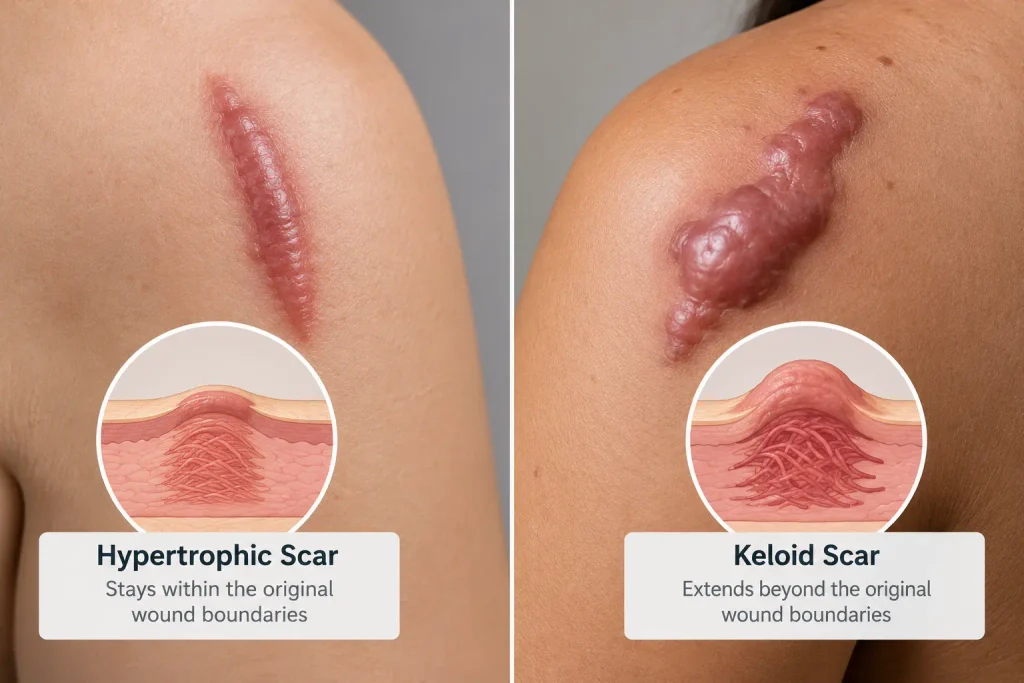
A hypertrophic scar stays within the boundaries of the original wound, while a keloid grows beyond them. Both can be raised, itchy, painful, or firm, but they behave differently over time and may require different treatment approaches.
Keloid vs Hypertrophic Scar: The Main Differences
The original wound’s outline is an important clue. A thick scar following the line of a surgical incision may be hypertrophic. Scar tissue spreading into previously uninjured skin is more suggestive of a keloid. However, an examination may be needed to confirm the diagnosis. [1,2]
| Feature | Hypertrophic scar | Keloid scar |
|---|---|---|
| Wound boundary | Stays within the original injury | Extends beyond the original injury |
| Growth pattern | May thicken initially, then gradually settle | May continue enlarging and usually persists |
| Natural improvement | Can soften and flatten over time | Does not usually flatten spontaneously |
| Symptoms | May itch, hurt, or feel tight | May itch, hurt, or feel tender |
| Return after surgical removal | Generally less likely than with keloids | A major concern, particularly with surgery alone |
These differences describe typical patterns, not a self-diagnosis checklist. Redness, firmness, and itching overlap, so none of these features alone identifies the scar type.
What Is a Hypertrophic Scar?
A hypertrophic scar forms when healing produces excessive scar tissue within the injured area. It can follow surgery, burns, or other injuries. Collagen, the protein that helps give skin its structure, builds up excessively during this process.
The scar may look raised and feel firm. Its colour can change as it matures, so colour alone is less useful than its boundaries and behaviour. Mechanical tension—pulling across the healing wound—can contribute to excessive scarring. [1]
A raised burn scar may also tighten and affect movement. This requires assessment of both the scar and its effect on function; it should not automatically be treated as a keloid. In a Keloid and Hypertrophic scar comparison, one of the most important distinctions is whether the scar remains within the boundaries of the original injury or grows beyond them.
Do Hypertrophic Scars Go Away?
Hypertrophic scars can gradually become flatter, softer, and less noticeable. This improvement may continue over years, but it does not mean the skin will return to its original appearance. [1]
There is no reliable deadline by which every scar should disappear. A comfortable scar that is improving may need a different approach from one that is painful, tightening, or restricting movement. Treatment decisions should reflect those differences.
What Is a Keloid Scar?
A keloid is an overgrowth of scar tissue that spreads beyond the initial injury. It can follow a piercing, acne, surgery, or another skin injury. Sometimes the original trigger was so small that the person does not remember it. [1]
Keloids can remain active for a long time. However, describing them as scars that “grow indefinitely” is too absolute: their behaviour varies, and not every keloid continues enlarging without stopping. Unlike hypertrophic scars, they do not usually regress naturally. [1]
Their location also matters. A scar on an earlobe presents different practical problems from a broad scar across the chest or shoulder. Size, symptoms, previous treatment, and the likelihood of further growth all influence management.
Can Symptoms Tell You Which Scar You Have?
Keloid vs Hypertrophic Scar comparison cannot be made from symptoms alone. Both types can itch, feel tender, or cause discomfort. Tightness and restricted movement can occur, particularly when scarring affects a joint. Having an itchy scar therefore does not, by itself, mean you have a keloid. [1,2]
A clinician will consider the original injury, whether the scar has crossed its boundaries, and how it has changed. Mention previous raised scars and any treatments you have already tried.
Occasionally, another skin condition can resemble a keloid. If the appearance is unusual or the diagnosis is uncertain, a dermatologist may recommend a biopsy: removing a small skin sample for examination. [2]
Seek prompt medical advice if the area becomes warm, swollen, increasingly painful, or produces pus. These changes should not simply be assumed to represent normal scar growth. [3]
Which Treatments May Help Raised Scars?
Treatment should match the scar type and the problem that matters most to you. Relief from itching, improved movement, and reduced thickness are different goals. A treatment that improves one feature may not fully address the others. [1]
Silicone Gel or Sheets
Silicone products may help soften and flatten raised scars, with much of the supporting evidence concerning hypertrophic scars. They work partly by maintaining hydration at the skin surface. They cannot reliably erase an established keloid. [1]
Use silicone only after the wound has healed, not over an open wound or scab. If a product causes a rash or skin irritation, stop and seek advice about an alternative. [2,4]
Corticosteroid Injections
Corticosteroid injections deliver medicine into the raised scar. They can reduce thickness and ease symptoms, although responses vary and repeat treatment may be needed. [1]
Possible side effects include skin thinning, visible small blood vessels, injection discomfort, and changes in skin colour. Discuss these risks alongside the expected benefit. [1,2]
Our guide to steroid injections for keloids explains this option for people with a confirmed keloid.
Pressure Therapy
Pressure garments are used in selected hypertrophic burn-scar care. Pressure earrings may also form part of treatment after ear-keloid surgery. These are specific applications; evidence from one setting should not be assumed to apply equally to every raised scar. [1]
Fit, comfort, and consistent use affect practicality. Pressure treatment should be professionally planned rather than improvised with tight jewellery or dressings. [1]
Cryotherapy and Laser Treatment
Cryotherapy freezes scar tissue and may help selected smaller keloids. Blistering and lasting lighter patches are possible, making skin-colour changes an important consideration, particularly for darker skin tones. [1,2]
Read more about cryotherapy for keloid scars when discussing whether freezing is appropriate for your scar.
Some lasers target blood vessels to improve redness; other approaches address different scar features. Laser treatment is not one uniform procedure, and results depend on the device, settings, and scar. Possible risks include pigment changes and blistering.
Why Is Keloid Recurrence Important Before Surgery?
Removing a keloid creates another wound in skin already prone to excessive scarring. The keloid can return and may become larger than before. Surgery alone therefore needs particular caution.
When surgery is appropriate, the plan often includes additional treatment, such as injections or pressure therapy for selected ear keloids. These measures aim to reduce recurrence; they do not guarantee permanent removal.
Hypertrophic scars generally have a lower risk of returning after excision. However, surgery may be unnecessary if the scar is still improving naturally. Wound tension and functional problems also affect the decision.
Before agreeing to removal, ask what will happen after the procedure, how follow-up will work, and what the next step would be if thickening returns.
Practical Patient Checklist
Before a scar consultation:
- Note the injury, operation, piercing, or acne episode that preceded the scar.
- Record whether growth remains within the original wound or extends beyond it.
- Bring dated photographs, ideally taken in similar lighting.
- Describe itching, pain, tightness, or effects on everyday movement.
- List previous treatments and whether they helped or caused side effects.
- Explain whether comfort, appearance, movement, or growth control is your priority.
- Ask about likely benefits, pigment changes, repeat treatment, and recurrence.
- Check when any recommended silicone product can safely be started.
Frequently Asked Questions
Are Keloids and Hypertrophic Scars the Same?
No. Both are raised scars, but hypertrophic scars stay within the original wound and may flatten over time. Keloids grow beyond the wound’s boundaries and usually persist.
Can a Hypertrophic Scar Turn Into a Keloid?
Hypertrophic scars are not generally considered to turn into keloids. However, the two can look similar early on. If a scar grows beyond the original wound, it should be reassessed because it may be a keloid.
Can Keloids and Hypertrophic Scars Come Back After Treatment?
Yes. Both can recur, but keloids are more likely to return, especially after surgery alone. Combining treatments may reduce this risk, although no treatment guarantees permanent removal. [1]
Conclusion
The key distinction in a keloid vs hypertrophic scar comparison is growth beyond the original wound. Hypertrophic scars may gradually settle; keloids usually persist and require particular attention to recurrence when treatment is planned.
An assessment can clarify the diagnosis and help you choose care based on symptoms, appearance, and realistic expectations. Book a consultation today.
Read Also / See Related
- Why is my scar getting bigger? — Learn what continued scar growth may mean and when to seek an assessment.
- Keloid symptoms — Explore common features such as firmness, itching, tenderness, and growth beyond the original wound.
- Post-burn keloid treatment — Understand why distinguishing a keloid from a hypertrophic burn scar matters when choosing treatment.
For additional patient information, see the American Academy of Dermatology’s guide to keloid diagnosis and treatment and the NHS overview of scars.
Sources
- [1]Gauglitz GG, Korting HC, Pavicic T, Ruzicka T, Jeschke MG. Hypertrophic Scarring and Keloids: Pathomechanisms and Current and Emerging Treatment Strategies. Molecular Medicine. 2011;17:113–125. Uploaded source. Full article and DOI.
- [2]American Academy of Dermatology. Keloid scars: Diagnosis and treatment. Patient guidance.
- [3]NHS. Scars. Patient guidance.
- [4]American Academy of Dermatology. Scars: Diagnosis and treatment. Patient guidance.
- [5]”Silver N. (2022). Hypertrophic Scars and Keloids: Similarities and Differences. Healthline. Medically reviewed by Debra Sullivan, Ph.D., MSN, R.N., CNE, COI. https://www.healthline.com/health/keloid-versus-hypertrophic-scar.”,
Medical disclaimer
The information in this article is provided for general educational purposes and does not replace professional medical advice, diagnosis, or treatment. Consult a dermatologist or another qualified healthcare professional about your symptoms and treatment options. Do not disregard professional medical advice or delay seeking care because of information you have read on KeloidCare.org. Responses to keloid treatments vary, and individual results cannot be guaranteed.
[…] Keloid vs. Hypertrophic Scar […]
[…] Keloid vs. Hypertrophic Scar […]
[…] Keloid vs. Hypertrophic Scar […]
[…] Keloid vs. Hypertrophic Scar […]
[…] Keloid vs. Hypertrophic Scar […]