
A burn scar may look red or darker than nearby skin. It may also feel dry, itchy, thick, or tight. If the burn was on your hand, even a small area of tight skin can make daily tasks harder. The right care depends on whether the wound has fully closed and what kind of scar has formed. You can often improve comfort and appearance, although complete removal is unlikely.
Quick Answer
Once a burn has fully healed, moisturising and sun protection can help you care for the new skin. A raised or tight scar may need assessment for silicone, pressure garments, therapy, injections, or laser treatment. Results vary, and a keloid needs a different plan from a typical raised burn scar.
What kind of burn scar do you have?
A scar forms as injured skin heals. How noticeable it becomes depends partly on the burn’s depth, size, location, and healing time. Its colour and texture can keep changing after the wound closes. Burn services describe these differences in their aftercare guidance [1].
- Flat scar or colour change: The skin may feel smooth but look pink, brown, pale, or darker than before.
- Hypertrophic scar: This raised, often firm scar stays within the original wound. It is a common concern after deeper burns.
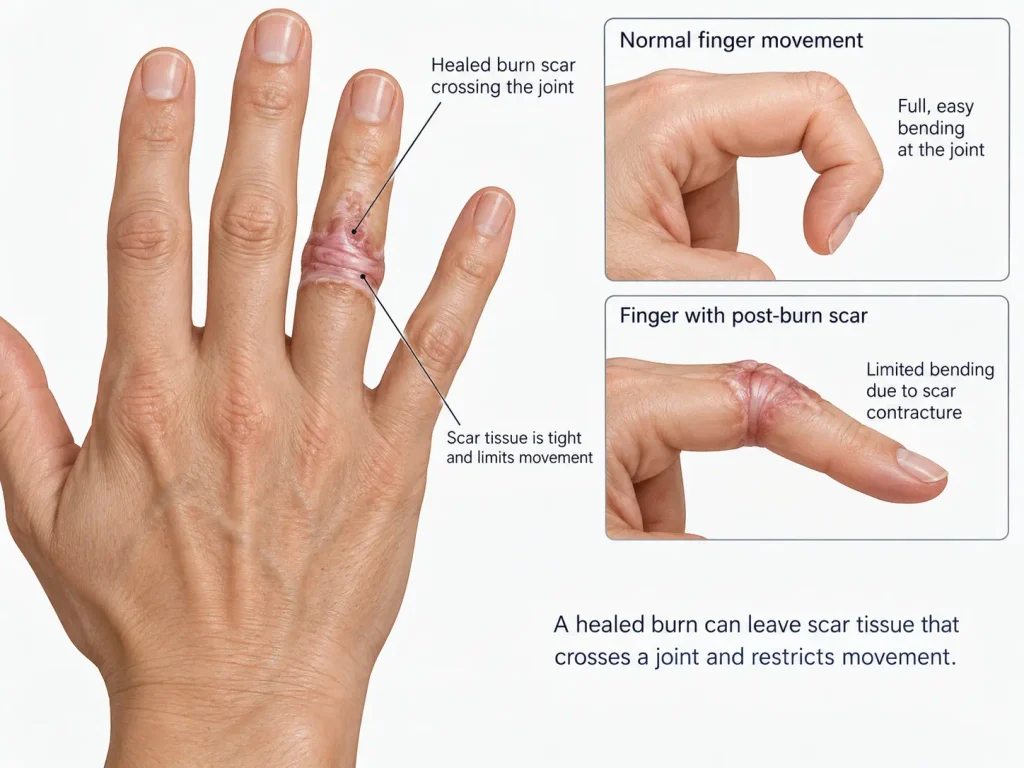
- Contracture: A tightening scar can restrict movement, particularly across a hand, finger, elbow, or other joint.
- Keloid: This raised scar grows beyond the original wound edge. It can occur after skin injury but is not the same as a hypertrophic burn scar.
The NHS description of scar types explains contractures and keloids [2]. If you cannot tell which type you have, ask a dermatologist or burn team before choosing a procedure.
Can a burn scar fade or disappear?
Many scars become less noticeable over time, but a mature scar usually does not disappear completely. The NHS says this process can take two years or longer [2]. A change in colour is different from a raised scar or a scar that pulls on a joint: each calls for a different goal.
It helps to define what “fade burn scars” means for you. Do you want less visible colour, a flatter surface, less itching, or easier movement? A treatment may help one of these without fixing all of them. Photos taken under similar lighting can help you and your clinician judge change over time.
How should you care for a healed burn scar?
Wait until the wound has fully closed before starting scar massage or using products intended for intact skin. An open burn needs wound care, not a scar treatment routine. The NHS advises massage only after complete healing [2].
For healed skin, these steps are reasonable starting points:
- Moisturise dry skin. A simple, non-perfumed moisturiser can ease dryness. Follow your burn team’s directions if you have had a graft or a special dressing. NHS burn aftercare recommends moisturising healed areas [1].
- Protect the area from sunlight. Cover it when practical and use sunscreen of SPF 30 or higher on exposed, healed skin. Sun can make a scar’s colour change more noticeable. NHS scar advice recommends both coverage and sunscreen [2].
- Ask before massaging sensitive skin. Massage is often part of burn rehabilitation after healing, but research on how much it changes the final scar remains mixed. A systematic review of burn scar massage reported improvements in some symptoms while noting inconsistent evidence for scar improvement [3]. Stop and seek advice if rubbing breaks the skin or worsens pain.
- Keep moving as your therapist advises. If a scar crosses a joint, prescribed exercises and splints may help preserve movement. Your own plan matters more than a generic stretching routine. Burn therapists describe this approach for contractures [4].
These steps support comfort and recovery. They cannot guarantee that a thick scar will flatten.
Burn scar treatment: Which options may help?
The appropriate choice depends on the scar’s shape, symptoms, age, and location. Some options are used routinely in burn services even where trials have not established how much better they are than alternatives.
| Option | What it may help with | Often considered for | Main limitation |
|---|---|---|---|
| Moisturiser and sun protection | Dryness and colour protection | Healed skin | Will not remove a raised scar |
| Silicone gel or sheets | Raised-scar management | Healed hypertrophic scars | Benefit over several alternatives is uncertain |
| Pressure garment | Managing raised scars | Selected, larger burn areas | Needs fitting; comparative benefit is uncertain |
| Steroid injection | Thickness, itching, or pain | Selected raised scars or keloids | Repeat treatment and side effects are possible |
| Laser treatment | Redness, texture, discomfort, or tightness | Selected established scars | May need repeat sessions; results vary |
| Rehabilitation or surgery | Movement limited by a contracture | Scars across joints | Requires specialist assessment |
Silicone gel and sheets
Silicone products cover a healed scar and are commonly offered for raised scars. A Cochrane review of hypertrophic scars found low or very low certainty evidence for many comparisons; whether sheets outperform no silicone for appearance remains uncertain [5]. They are not a way to erase a scar.
Evidence for a true keloid must be considered separately. A different Cochrane review could not establish whether silicone sheets improve established keloids compared with no treatment [6].
Pressure garments and movement therapy
A burn team may fit a garment to apply even pressure over a healing scar. The goal is to manage a raised, hypertrophic scar. Yet a Cochrane review of pressure garments after burns could not determine whether they prevent raised scars better than other scar care [7]. Fitting and follow-up matter; do not improvise tight wrapping.
If the skin pulls on a finger or joint, treatment also needs to address movement. A burn therapist may recommend exercises, positioning, or a splint, with surgery considered for some persistent contractures. Specialist burn guidance explains why the plan is tailored to the affected joint [4].
Injections and laser treatment
Steroid injections place medicine directly into a raised scar. They can reduce size and ease itch or pain, but several sessions may be needed. Possible effects include skin thinning and pigment changes. These are treatments described by the American Academy of Dermatology for raised scars and keloids [8]. They are not usually needed for a flat colour change.
Laser treatment can aim to improve redness, texture, discomfort, or restricted movement. It does not make the scar vanish. The American Academy of Dermatology’s laser guidance stresses individual assessment [9]. A Cochrane review of lasers for hypertrophic scars and keloids found that evidence is too uncertain to rank laser approaches confidently [10]. Ask which scar feature a proposed laser is intended to improve.
What about creams and home remedies?
A plain moisturiser may help a healed scar feel less dry. That is different from removing it. Burn therapists note that specialty scar creams have not shown an advantage over simple moisturiser for hydration and massage [11]. Treat claims that an oil or cream can permanently erase a burn scar with caution.
Never use scar massage or silicone products over an open wound unless your treating team specifically instructs you to. If the burn is recent, use appropriate first aid rather than a scar routine: the NHS recommends cool running water for 20 minutes and advises against applying oils or butter [12].
What if the burn scar is on your hand?
A burn scar on hand skin deserves attention when fingers feel tight or you cannot bend and straighten them normally. Scars over joints can become contractures, meaning they pull the skin and limit motion. A burn therapy service lists hands and fingers among sites at risk [4].
Ask your burn team or hand therapist to check movement and demonstrate suitable exercises. A splint or tailored rehabilitation plan may be useful. If the hand burn is new, deep, or still open, seek prompt medical assessment; the American Burn Association referral guidance gives special attention to burns involving the hands [13].
When should you ask for professional advice?
See a clinician if your scar grows beyond the original burn, thickens rapidly, repeatedly breaks open, or causes troublesome itch or burn scar pain. Seek assessment if tightness affects movement or daily tasks. A clinician can distinguish a hypertrophic scar from a keloid and discuss realistic options.
For a new burn, arrange urgent medical care if it is large or deep, involves the face or genitals, or was caused by electricity or chemicals. NHS urgent-care advice addresses these situations [12]. A hand burn also deserves a low threshold for assessment [13].
Practical Patient Checklist
Before your appointment:
- Note when the burn healed and whether the scar is still changing.
- Take photos and list any products or treatments you have tried.
- Describe whether colour, itching, pain, thickness, or movement bothers you most.
- Show the clinician exactly where a hand or joint feels tight.
- Ask what improvement is realistic, how long treatment takes, and what side effects to expect.
Read Also / See Related
- Keloid vs. hypertrophic scar — Understand the difference between two types of raised scars and why identifying the scar matters before choosing treatment.
- Post-burn keloid treatment — Explore treatment options that may be discussed if a clinician confirms that your burn scar is a keloid.
Conclusion
The most useful way to treat a burn scar starts with identifying its type and your main concern. Moisturiser and sun protection can support healed skin. Raised scars, persistent pain, or restricted movement may benefit from a tailored treatment plan, while a true keloid needs its own assessment. None of these options promises complete removal.
Book a consultation today if the scar is painful, growing, or limiting movement. If it appears to extend beyond the burn, our related guides can help you prepare questions about keloid treatments.
Sources
- [1] Chelsea and Westminster Hospital NHS Foundation Trust — Burns — Patient leaflet.
- [2] National Health Service — Scars — NHS guidance.
- [3] Lin TR et al. — 2023 — Effects of scar massage on burn scars: A systematic review and meta-analysis — Journal of Clinical Nursing — DOI: 10.1111/jocn.16420.
- [4] Chelsea and Westminster Hospital NHS Foundation Trust — Scar tissue and contractures: Initial stage — Burn therapy guidance.
- [5] Cochrane Wounds — 2021 — Silicone gel sheeting for treating hypertrophic scars — Cochrane evidence summary.
- [6] Tian F et al. — 2023 — Silicone gel sheeting for treating keloid scars — Cochrane Database of Systematic Reviews — DOI: 10.1002/14651858.CD013878.pub2.
- [7] Cochrane Wounds — 2024 — Pressure-garment therapy for preventing hypertrophic scarring after burn injury — Cochrane evidence summary.
- [8] American Academy of Dermatology — Scars: Diagnosis and treatment — AAD guidance.
- [9] American Academy of Dermatology — 10 things to know before having laser treatment for your scar — AAD guidance.
- [10] Cochrane Wounds — 2022 — Laser therapy for hypertrophic and keloid scars — Cochrane evidence summary.
- [11] Chelsea and Westminster Hospital NHS Foundation Trust — Massage and moisturiser — Burns therapy guidance.
- [12] National Health Service — Burns and scalds — NHS guidance.
- [13] American Burn Association — Guidelines for Burn Patient Referral — ABA guidance
Medical disclaimer
The information in this article is provided for general educational purposes and does not replace professional medical advice, diagnosis, or treatment. Consult a dermatologist or another qualified healthcare professional about your symptoms and treatment options. Do not disregard professional medical advice or delay seeking care because of information you have read on KeloidCare.org. Responses to keloid treatments vary, and individual results cannot be guaranteed.