

Pitted acne scar treatment can soften depressions and make skin texture more even, but it cannot promise completely smooth skin. The most useful starting point is identifying each scar’s shape and depth. A narrow pit may need a different approach from a broad dip held down by scar tissue. [1,2]
You do not have to treat scars if they do not bother you. If they do, understanding these differences can help you discuss realistic options.
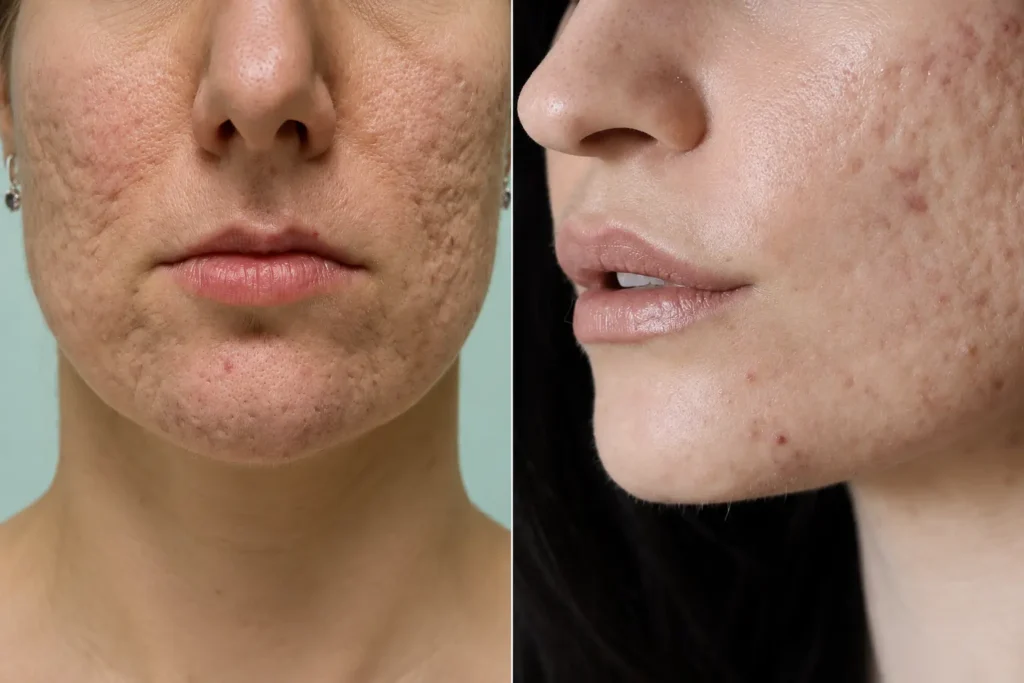
Which Pitted Acne Scar Treatment Fits Your Scar Shape?
Pitted scars are also called atrophic scars: areas where tissue loss leaves a depression. They differ from flat red or brown acne marks, which change skin colour without creating a pit. [1]
Dermatologists generally group these depressions into three patterns. Many people have a mixture, so one treatment across the whole face may leave some scars largely unchanged. [1,2]
| Scar pattern | Typical appearance | Approaches a clinician may consider |
|---|---|---|
| Ice pick | Narrow opening with a deep tract | TCA CROSS or punch excision for selected pits |
| Boxcar | Round or oval depression with distinct edges | Resurfacing for shallower scars; punch elevation or excision for selected deeper scars |
| Rolling | Broad dips creating an uneven, wavy surface | Subcision when underlying bands tether the skin; resurfacing may address remaining texture |
These are starting points, not a diagnosis or a fixed treatment menu. Both the systematic review by Bhargava and colleagues and the review of atrophic acne-scar treatments by Hession and Graber describe scar-specific approaches. [1,2]
Treating Deep Pitted Acne Scars: Address Individual Pits
Deep scars often need focused treatment before broader surface treatments. Resurfacing alone may not adequately treat a deep ice pick scar or release a tether beneath the skin. [1,2]
TCA CROSS for Narrow Pits
TCA CROSS means applying trichloroacetic acid precisely inside selected scars to trigger local repair and collagen formation. Collagen is a protein that supports skin. This differs from spreading a peel across a larger area. [1,2]
It is used particularly for ice pick scars, sometimes over several sessions. Crusting and temporary colour changes can occur; incorrect application can damage surrounding skin. This is a clinician-performed procedure, not a home acid treatment. [1]
Punch Procedures for Selected Deep Scars
Punch excision removes an individual scar with a small surgical tool. The opening is then closed or allowed to heal. Punch elevation instead lifts the base of a suitable depressed scar closer to the surrounding surface. [1,2]
These procedures aim to exchange a conspicuous pit for a less noticeable contour or surgical scar. They cannot create scar-free skin, and later resurfacing may still be considered. Evidence for some punch techniques comes from small studies, so precise outcome predictions are uncertain. [1,2]
Where Does Subcision Fit?
Subcision passes a needle or cannula beneath the scar to release bands pulling the skin down. Its suitability depends on tethering, rather than depth alone. [1]
Its clearest role is in tethered rolling scars. Selected tethered boxcar scars may also benefit, but narrow ice pick scars usually need another approach. Bruising, bleeding, swelling, and infection are possible complications. [1,2]
Subcision may therefore be one part of a pitted acne scar treatment plan, with other procedures addressing remaining pits or surface texture.
Microneedling vs Fractional CO₂ Laser for Scars
Both approaches create controlled injury to encourage skin repair, but they do so differently. Neither reliably corrects every scar pattern, and comparisons depend on the devices, settings, scars, and outcomes measured. [1]
Conventional microneedling uses fine needles to make small punctures. It may improve atrophic scar texture and often involves several appointments. It generally has a lighter recovery burden than ablative laser resurfacing, but deep pits may need targeted treatment as well. [1]
Fractional CO₂ laser treats tiny columns of skin while leaving areas between them untreated. It removes tissue within those columns and delivers heat, encouraging remodelling. It can improve atrophic scars, but more intensive treatment generally brings greater healing demands and potential complications. [1,3]
Our guide to CO₂ laser treatment for the face provides further information about this resurfacing approach.
Discuss likely redness, discomfort, wound care, and time away from usual activities before choosing. Microneedling can cause bleeding, irritation, infection, or pigment changes. CO₂ laser can cause prolonged redness, infection, pigment changes, and additional scarring. These laser complications are discussed in Ramsdell’s review of fractional CO₂ resurfacing, while the FDA’s microneedling guidance explains device-related precautions. [3,4]
Radiofrequency Microneedling Is a Separate Procedure
Radiofrequency microneedling adds heat through needles placed in the skin. It should not be treated as interchangeable with conventional microneedling.
In its 15 October 2025 safety communication, the FDA reported serious complications associated with certain uses, including burns, scarring, fat loss, disfigurement, and nerve damage. [5]
Ask which device is proposed, why it suits your scars, and what training the clinician has in using it. RF microneedling should not be performed at home. [5]
Is There a Best Laser for Indented Acne Scars?
There is no single best laser for every patient. Fractional CO₂ is an ablative option, meaning it removes small areas of tissue. Non-ablative fractional lasers heat tissue without removing the skin surface in the same way. [1]
Non-ablative treatment generally offers less downtime, but may require more sessions and produce more modest changes. The trade-off depends on the individual device and treatment settings, not simply the word “laser”. [1]
Skin tone also matters. Post-inflammatory hyperpigmentation means darkening after skin injury; this is a particular concern in darker skin. A history of pigment changes, abnormal scarring, or poor healing should shape the plan. [1,3]
Ask the clinician about experience with your skin tone and scar pattern. A device name alone cannot establish whether a procedure is suitable for you.
Can Creams or Home Care Fill the Pits?
Topical treatment may make mild scarring less noticeable, but established deep depressions usually need procedures for meaningful contour change. Treating ongoing acne is also important before scar procedures, because new breakouts can create further scars. [1,6]
A retinoid may have a role in an individual skin-care plan. However, fading discolouration is different from lifting a deep scar. The American Academy of Dermatology’s acne-scar treatment guide explains how treatment is selected. [6]
Avoid trying to reproduce professional needling or acid procedures at home. Skin penetration carries infection and pigment risks, while focal acid treatment requires precise placement. Ask for a skin-care plan compatible with the procedure you choose. [1,4]
How Should You Judge Before-and-After Results?
When viewing pitted acne scar treatment before-and-after photographs, look beyond the most dramatic example. Ask whether the patient had similar scars and skin tone, and whether several treatments contributed.
Check that lighting, camera angle, facial expression, and image distance match. Ask when the final photograph was taken. A photograph taken during early swelling is not a reliable guide to the settled result.
Collagen remodelling takes time, and improvement may continue after the initial healing period. Treatment studies use different scoring systems and follow-up periods, making a single promised improvement percentage misleading. [1,2]
For mixed scars, a staged plan may address tethering or individual pits first, then surface texture. Agree which changes matter most to you and when the result will be reviewed before adding another procedure. [1]
Practical Patient Checklist
Before your appointment:
- Ask which scars are ice pick, boxcar, or rolling, and which are tethered.
- Explain whether your priority is individual deep pits, overall texture, or colour marks.
- Share your acne treatment, medicines, cold sore history, and previous healing problems. [3,4]
- Request a recovery plan covering skin care, sun protection, and follow-up. [3]
- Ask about the total likely course, cost, alternatives, and realistic stopping point.
- Confirm whom to contact if healing seems abnormal after treatment.
Conclusion
Effective pitted acne scar treatment starts with matching the procedure to the scar. Targeted treatment may help deep or tethered scars, while resurfacing can improve broader texture. The goal is worthwhile improvement, with realistic expectations about remaining scars and recovery. [1,2]
Book a consultation to discuss your scar pattern and a treatment plan suited to your priorities.
Read Also / See Related
- Red scar healing — Understand why persistent redness needs a different assessment from a depressed scar.
- Facial scar healing — Learn how wound care and longer-term scar care differ as skin heals.
Sources
- [1] Bhargava S., Cunha P.R., Lee J., Kroumpouzos G. — 2018 — Acne Scarring Management: Systematic Review and Evaluation of the Evidence. American Journal of Clinical Dermatology, 19(4), 459–477. DOI: 10.1007/s40257-018-0358-5.
- [2] Hession M.T., Graber E.M. — 2015 — Atrophic Acne Scarring: A Review of Treatment Options. Journal of Clinical and Aesthetic Dermatology, 8(1), 50–58. Full article.
- [3] Ramsdell W.M. — 2012 — Fractional CO₂ Laser Resurfacing Complications. Seminars in Plastic Surgery, 26(3), 137–140. Full article.
- [4] US Food and Drug Administration — Microneedling Devices. Includes the 15 October 2025 safety update. Device information and precautions.
- [5] US Food and Drug Administration — 15 October 2025 — Potential Risks with Certain Uses of Radiofrequency (RF) Microneedling. Safety communication.
- [6] American Academy of Dermatology — Acne scars: Consultation and treatment. Patient treatment guide.
Medical disclaimer
The information in this article is provided for general educational purposes and does not replace professional medical advice, diagnosis, or treatment. Consult a dermatologist or another qualified healthcare professional about your symptoms and treatment options. Do not disregard professional medical advice or delay seeking care because of information you have read on KeloidCare.org. Responses to keloid treatments vary, and individual results cannot be guaranteed.