

Keloid scars are a challenging condition that affects many individuals worldwide. Despite their prevalence, there is often confusion about their diagnosis and treatment. In this article, we explore evidence-based approaches to managing keloid scars, including established treatments and therapies still under investigation.
Understanding Keloid Scars
Keloid scars are raised, thickened areas of skin that develop after an injury. Unlike hypertrophic scars, keloids grow beyond the boundary of the original wound. They are more common in individuals with darker skin tones and can be itchy, tender, and cosmetically concerning.
Newly formed keloid scars may initially appear raised or firm, with a color that differs from the surrounding skin. They can gradually extend beyond the original injury, although not every newly raised scar becomes a keloid.
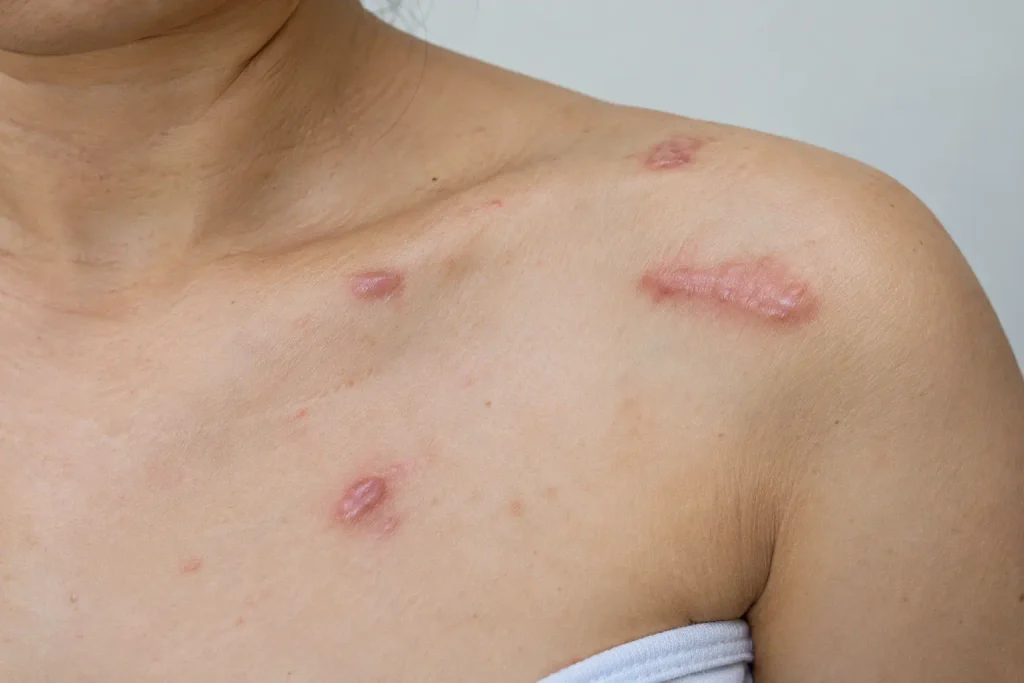
Diagnosis of Keloid Scars
The diagnosis of keloid scars is primarily clinical, based on the scar’s appearance, growth pattern, and history. Dermatologists may consider a biopsy if the diagnosis is uncertain or another skin condition needs to be ruled out.
Accurate diagnosis is important because keloids and hypertrophic scars can look similar, particularly early in their development. Recognizing newly formed keloid scars allows appropriate assessment and management to begin, although early treatment cannot guarantee that further growth will be prevented.
Evidence-Based Treatments for Keloid Scars
Corticosteroid Injections
Intralesional corticosteroid injections are a well-established first-line treatment for keloids. They work by reducing inflammation and excessive scar-tissue activity.
According to Ekstein et al. (2021), corticosteroid injections can flatten keloids and reduce symptoms such as itching and pain. However, results vary, repeated treatments may be needed, and recurrence remains possible. Potential side effects include skin thinning and pigment changes.
Laser Treatment for Keloid Scars
Laser treatment may be considered to improve selected scar features, including redness, texture, or thickness. Different lasers have different purposes, and they are often used alongside other treatments.
Tripathi et al. (2020) discuss laser-based approaches within the broader management of hypertrophic scars and keloids. However, the 2022 Cochrane review found that evidence for laser treatment was limited and generally of low or very low certainty. Laser therapy should therefore not be presented as a reliably superior treatment for newly formed keloid scars.
Silicone Sheets and Pressure Therapy
Silicone sheets and silicone gel are non-invasive options used in scar care. For newly formed keloid scars, silicone-based therapy may be considered as part of an early management plan once the skin has fully healed.
Silicone helps maintain hydration, but its ability to flatten established keloids remains uncertain. The 2023 Cochrane review of silicone gel sheeting found very low-certainty evidence. Silicone should not be applied to an open wound or scab.
Pressure therapy is a separate treatment that uses fitted garments or devices. It is particularly relevant to ear keloids, often after surgical removal. A systematic review by Tahir et al. (2024) supports its use in postoperative care while highlighting limitations in the available studies. The device and wear schedule should be selected by the treating clinician.
Emerging and Novel Therapies for Keloids
Treatments Still Under Investigation
Research into keloid biology has identified several potential treatments, including topical mitomycin C and botulinum toxin injections. These approaches have been studied for years and should not be described as new breakthroughs specific to 2025.
Ekstein et al. discuss mitomycin C as an agent that inhibits cell proliferation and has been investigated after keloid excision. Evidence remains limited, and it is not a routine home treatment for a newly forming scar.
A review of botulinum toxin in keloid management describes potential effects on wound tension and fibroblast activity. However, further research is needed to establish its effectiveness, appropriate use, and long-term outcomes.
Recent Progress in Keloid Mechanism and Treatment
Understanding the molecular mechanisms underlying keloid formation is important for developing new therapies. Research has examined genetic and epigenetic factors, as well as the role of growth factors and cytokines.
Limandjaja et al. (2020) describe these interacting mechanisms and the biological complexity of keloids. Identifying a possible treatment target does not necessarily mean that an effective clinical treatment is already available.
What Does the Future Hold?
Ongoing research may lead to more targeted approaches, but proposed treatments need well-designed clinical studies before their benefits and risks can be established.
Future research may also help clarify which early interventions are most effective for newly formed keloid scars. For now, treatment should be guided by the diagnosis, scar characteristics, symptoms, and response to established options.
Conclusion
Keloid scars present a challenge, but available treatments can help improve their appearance and symptoms. Newly formed keloid scars should be assessed before assuming that a particular product or procedure will prevent further growth.
If you are concerned about a developing scar, consider booking a consultation with a dermatologist to confirm the diagnosis and discuss suitable treatment options.
For more information, visit our dedicated pages on silicone gel for keloids and pressure therapy for ear keloids.
References
- American Academy of Dermatology Association. Keloid scars: Diagnosis and treatment. Available at: https://www.aad.org/public/diseases/a-z/keloids-treatment.
- Ekstein SF, Wyles SP, Moran SL, Meves A. Keloids: a review of therapeutic management. International Journal of Dermatology. 2021;60(6):661–671. doi: 10.1111/ijd.15159.
- Tripathi S, Soni K, Agrawal P, Gour V, Mondal R, Soni V. Hypertrophic scars and keloids: a review and current treatment modalities. Biomedical Dermatology. 2020;4:11. doi: 10.1186/s41702-020-00063-8.
- Leszczynski R, da Silva CAP, Pinto ACPN, Kuczynski U, da Silva EMK. Laser therapy for treating hypertrophic and keloid scars. Cochrane Database of Systematic Reviews. 2022;9. doi: 10.1002/14651858.CD011642.pub2.
- Tian F, Jiang Q, Chen J, Liu Z. Silicone gel sheeting for treating keloid scars. Cochrane Database of Systematic Reviews. 2023;1. doi: 10.1002/14651858.CD013878.pub2.
- Tahir SM, Ihebom D, Simman R. Compression therapy for keloid scars: a systematic review and meta-analysis. Plastic and Reconstructive Surgery – Global Open. 2024;12(6). doi: 10.1097/GOX.0000000000005864.
- Goutos I. The use of botulinum toxin in keloid scar management: a literature review. Scars, Burns & Healing. 2020;6. Available at: https://pmc.ncbi.nlm.nih.gov/articles/PMC7323272/.
- Limandjaja GC, Niessen FB, Scheper RJ, Gibbs S. The keloid disorder: heterogeneity, histopathology, mechanisms and models. Frontiers in Cell and Developmental Biology. 2020;8:360. Available at: https://pmc.ncbi.nlm.nih.gov/articles/PMC7264387/.
Medical disclaimer
The information in this article is provided for general educational purposes and does not replace professional medical advice, diagnosis, or treatment. Consult a dermatologist or another qualified healthcare professional about your symptoms and treatment options. Do not disregard professional medical advice or delay seeking care because of information you have read on KeloidCare.org. Responses to keloid treatments vary, and individual results cannot be guaranteed.
[…] Newly formed keloid scars — Explore early assessment and where silicone-based care may fit into a treatment plan. […]
[…] Newly Formed Keloids […]
[…] Newly Formed Keloids […]