

A hair transplant scar can look like a narrow line, scattered pale dots, or an unusually raised area. These patterns have different causes and need different assessments. Neither of the main transplant techniques is scar-free. [1,2]
The first question is whether you are seeing early healing, an established scar, or reduced hair coverage that makes the scalp more visible. Understanding that distinction helps you judge whether time, camouflage, or treatment may help.
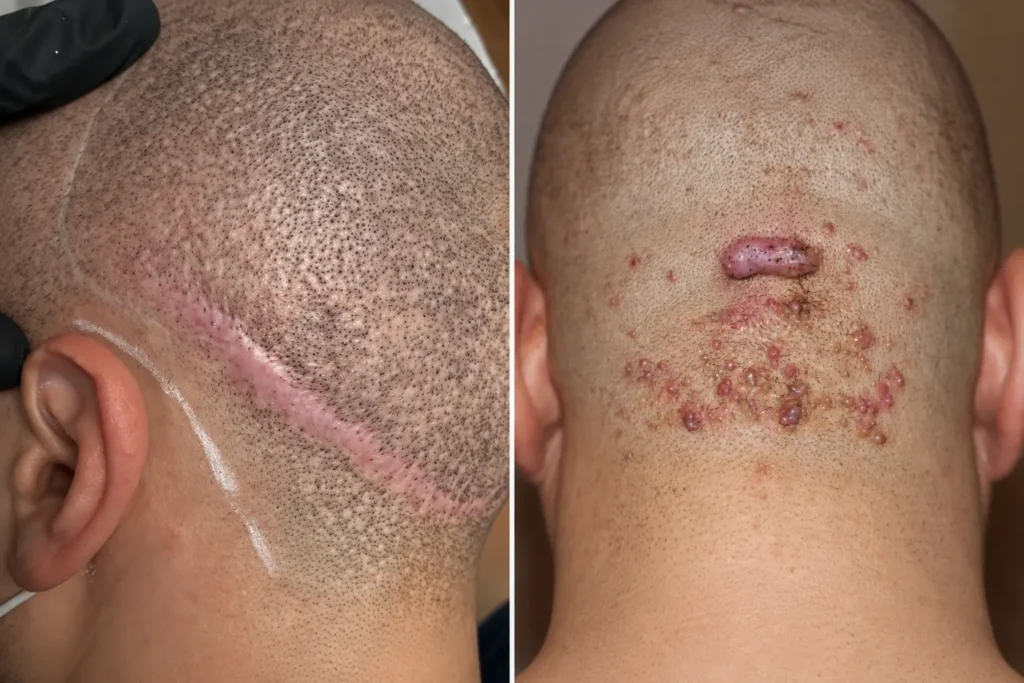
FUE vs FUT Scarring: What Does Each Technique Leave?
The donor area is where hair follicles are removed, usually from the back or sides of the scalp. The recipient area is where those follicles are placed.
With follicular unit transplantation using the strip method (FUT), the surgeon removes a strip of hair-bearing skin and closes the wound. With follicular unit excision, also commonly called extraction (FUE), individual follicular units are removed using small circular cuts. Both create scars. The NHS hair-transplant guide explains these procedural differences. [1,2]
| Feature | FUT | FUE |
|---|---|---|
| Donor removal method | A strip of skin is removed | Individual follicular units are removed |
| Typical scar pattern | A linear scar | Numerous small, round scars |
| Possible visibility issue | The line may show with short hair or if it widens | Dots may show with close shaving or reduced hair coverage |
| Other donor concerns | Wound tension and scar widening | Overharvesting and patchy thinning |
| Scar-free result? | No | No |
These differences describe typical patterns, not guaranteed outcomes. The procedure, healing response, and remaining hair coverage influence visibility. [1,2,4]
A technique that avoids a linear scar does not avoid scarring altogether. Ask to see healed donor-area photographs at a hair length similar to the style you want.
Hair Transplant Scar Healing Timeline
Wound closure, scar maturation, and hair growth follow different schedules. Looking ready to return to work does not mean a scar has reached its final appearance.
The First Days and Weeks
The scalp may feel tight, sore, or swollen, and temporary scabs can form. The NHS advises particular care with transplanted grafts during the first two weeks. Follow your surgeon’s instructions for washing, exercise, and wound care. [1]
If FUT closure uses non-dissolving stitches, removal commonly takes place around 10–14 days. Your surgeon should confirm the timing. [1]
The Following Months
Scars continue to reorganise beneath the surface after wounds close. Their colour, firmness, and thickness may change during maturation. General scar research describes changes continuing for a year or longer; that is not a precise deadline for every scalp scar. [3]
Early photographs therefore cannot reliably show the final scar result. Our guide to red scar healing explains why colour can persist after a wound has closed.
Hair Growth Is a Separate Milestone
The NHS describes full transplant results becoming apparent around 10–18 months. This refers to the overall transplant outcome, not a promise that scars disappear by then. [1]
Ask your surgeon when they expect to assess scar appearance separately from hair growth. A scar that is becoming increasingly raised or painful should be reviewed sooner.
Is Donor-Area Thinning the Same as Scarring?
No. Donor-area scarring after a hair transplant can coexist with hair loss, but the two are not interchangeable.
The review of hair-transplant complications by Kerure and Patwardhan distinguishes temporary postoperative shedding from donor depletion and overharvesting. Removing too many follicles can leave lasting patchy thinning, while postoperative shedding may recover. [4]
Scar tissue and missing hair coverage can also reinforce each other visually: less surrounding hair may make individual extraction scars easier to see. [2,4]
This matters when discussing repair. A treatment aimed at softening a raised scar cannot replace missing follicles. Likewise, adding visual coverage does not remove the underlying scar.
Bring your operation details, earlier photographs, and the approximate graft count to an assessment. Ask the clinician to identify which features reflect scar tissue, temporary change, or reduced donor density.
When Does a Hair Transplant Scar Need Assessment?
Contact your surgical team promptly for severe pain or unexpected symptoms. A warm, swollen, increasingly painful area or pus needs urgent medical advice rather than a routine cosmetic review. The NHS scar-care guidance identifies these as reasons to seek urgent assessment. [1,5]
Arrange an assessment for persistent thickening, growth, or troublesome itching.
A hypertrophic scar rises above the skin but stays within the original injury. A keloid extends beyond it and usually persists. The distinction between a keloid and a hypertrophic scar can be difficult to establish from appearance alone, especially across multiple extraction sites. [3]
The case report by Alhamzawi describes keloids developing after FUE in a patient without a previous keloid history. This confirms that FUE does not eliminate the possibility. However, a single case report cannot establish how frequently it happens. [2]
The report also cannot show that every raised donor scar is a keloid or that a particular surgical error caused it.
How to Hide Hair Transplant Scars
For a healed, stable scar, camouflage may be enough to meet your goal.
Hair Length and Styling
Keeping surrounding hair longer or changing its direction may reduce visibility. Whether this works depends on the scar’s position and available coverage. The International Society of Hair Restoration Surgery’s repair guidance also describes cosmetic powders and concealers as possible options. [6]
Ask your surgeon when products can be used after surgery. Fresh wounds and newly placed grafts need their prescribed aftercare first.
Scalp Micropigmentation
Scalp micropigmentation, or SMP, places small pigment dots in the skin to imitate the appearance of closely cropped hair. It can reduce the visual contrast of selected FUE or FUT scars. It does not grow hair or flatten scar tissue. [7]
The ISHRS guide to scalp micropigmentation notes that pigment placement in scars is demanding. Pigment may spread, fade, or change colour unpredictably. [7]
Discuss timing, skin stability, and the likely need for maintenance with an experienced practitioner. If the area is still inflamed or raised, seek medical assessment before choosing camouflage.
Hair Transplant Scar Repair Options
Repair should target the feature that bothers you: visible dots, a widened line, uneven texture, or raised tissue. These are different problems.
Transplanting Hair Into Selected Scars
Hair grafts can sometimes improve coverage over a scalp scar. However, scar thickness and blood supply influence whether grafts can survive. Some scars are unsuitable, and the surgeon may consider a small test area before a larger procedure. The ISHRS guidance on hair restoration in scarred scalp explains these assessment considerations. [8]
This guidance concerns scarred scalps broadly; it does not guarantee success in every transplant donor scar.
Further grafting also uses donor resources and creates additional harvesting wounds. A repair plan should explain where the hair will come from and what limitations remain. [2,6]
Revising a Widened Linear Scar
Selected scars may be surgically removed and closed again to improve their size or shape. Revision creates a new scar rather than erasing the old one without a trace. [3,8]
The available scalp tissue, wound tension, and previous healing response need assessment. Poorly planned corrective surgery can worsen scarring or further deplete the donor area. [3,6]
Treating a Raised Scar or Keloid
For a confirmed raised scar, a clinician may discuss silicone after wound healing or injections to reduce thickness and symptoms. These treatments address scar tissue, not ordinary flat extraction dots or donor depletion. [2,3]
Silicone gel for keloids may form part of a treatment plan once the skin has healed. Suitability and application should be discussed with the clinician, particularly on a hair-bearing scalp.
Steroid injections for keloids may soften or flatten raised tissue. Possible side effects include pain, skin thinning, and visible small blood vessels. Keloids can recur after improvement. [3]
In the FUE case report, the patient improved after combined silicone and steroid treatment. That observation supports considering the approach, but it does not prove a predictable result for other patients. [2]
Cryotherapy for keloids may be considered for selected smaller raised scars. It can cause blistering, pain, and lasting pigment changes. Suitability on a hair-bearing scalp requires individual discussion. [3]
What Can Reduce the Risk Before Another Procedure?
Tell the surgeon about previous keloids, widened scars, delayed healing, and reactions after earlier operations. Good planning should account for both the scalp and your healing history. [2,3]
Discuss donor limits and your preferred hairstyle before agreeing to further harvesting. The goal is to preserve enough coverage while addressing your main concern. [6]
Follow the personalised aftercare plan and attend reviews. If an area becomes unexpectedly painful, inflamed, or raised, report it rather than waiting for the final hair-growth result.
Be cautious about promises that an extra product makes transplantation scar-free. Suggestions in a case report do not establish a proven prevention method. Ask what evidence supports any proposed additional treatment specifically for donor-scar outcomes.
Practical Patient Checklist
At your consultation:
- Confirm whether the concern is scar tissue, thinning, or both.
- Bring operation records and dated photographs.
- Mention personal or family histories of keloids.
- Explain your preferred hair length and main treatment goal.
- Ask whether camouflage could meet that goal without further surgery.
- Discuss donor availability, pigment risks, and recurrence where relevant.
- Agree on review timing and symptoms that need earlier contact.
Conclusion
A hair transplant scar may become less noticeable as it matures or gains surrounding hair coverage. Persistent visibility may be addressed through camouflage or carefully selected repair, while raised, growing scars need a separate assessment. [3,6]
Book a consultation to identify what is causing the appearance and discuss realistic options for your scalp and remaining donor hair.
Read Also / See Related
- Scar getting bigger — Understand why a changing scar may need assessment rather than camouflage alone.
- Keloid symptoms — Explore itching, tenderness, and growth associated with raised keloid scars.
- Tattoo scars and keloids — Learn about abnormal scarring after skin tattooing, a relevant consideration when discussing pigment-based camouflage.
Sources
- [1] NHS — Hair transplant. Procedure, recovery, and complications.
- [2] Alhamzawi N.K. — 2020 — Keloid Scars Arising after Follicular Unit Extraction Hair Transplantation. Journal of Cutaneous and Aesthetic Surgery, 13(3), 237–239. DOI: 10.4103/JCAS.JCAS_181_19. Case report.
- [3] Gauglitz G.G., Korting H.C., Pavicic T., Ruzicka T., Jeschke M.G. — 2011 — Hypertrophic Scarring and Keloids: Pathomechanisms and Current and Emerging Treatment Strategies. Molecular Medicine, 17, 113–125. DOI: 10.2119/molmed.2009.00153.
- [4] Kerure A.S., Patwardhan N. — 2018 — Complications in Hair Transplantation. Journal of Cutaneous and Aesthetic Surgery, 11(4), 182–189. Review article.
- [5] NHS — Scars. Scar care and urgent assessment advice.
- [6] International Society of Hair Restoration Surgery — Revision and Repair of Previous Hair Transplants. Specialist repair guidance.
- [7] International Society of Hair Restoration Surgery — Scalp Micropigmentation (SMP): All You Need to Know. Camouflage benefits and limitations.
- [8] International Society of Hair Restoration Surgery — Is It Possible to Do a Hair Transplant on a Scar? Assessment of scarred scalp tissue.
Medical disclaimer
The information in this article is provided for general educational purposes and does not replace professional medical advice, diagnosis, or treatment. Consult a dermatologist or another qualified healthcare professional about your symptoms and treatment options. Do not disregard professional medical advice or delay seeking care because of information you have read on KeloidCare.org. Responses to keloid treatments vary, and individual results cannot be guaranteed.