

Red scar healing can continue long after a wound closes. The surface may be intact while the tissue underneath is still remodelling, so a pink or red appearance does not automatically mean something is wrong. Understanding the scar’s age, thickness, symptoms, and direction of change helps guide appropriate care. [1,2]
Is the Redness Stable, or Is It Getting Worse?
Start with the pattern of change. A closed scar that remains pink while gradually becoming softer is different from a wound developing spreading redness and increasing pain. Normal early wound discomfort should generally improve rather than keep intensifying. [1,4]
| What you notice | What it may suggest | Sensible next step |
|---|---|---|
| Colour stays within a closed scar and gradually fades | Ongoing scar maturation | Continue appropriate care and monitor changes. |
| Increasing redness around the wound, warmth, swelling, or pain | Possible infection or another complication | Seek prompt medical advice. |
| A scar becomes increasingly raised, firm, or itchy | Excessive scar formation may be developing | Arrange a scar assessment. |
| A rash appears where a silicone sheet touches the skin | Possible irritation from the product | Pause the sheet and contact your clinician. |
These patterns help guide assessment; they cannot establish a diagnosis from appearance alone. [1,2,4,6]
Seek urgent advice if redness spreads or the area becomes increasingly hot, painful, swollen, or starts draining pus. The University Hospitals Sussex guide to wound infection explains these warning signs. In the UK, contact your care team, GP, or NHS 111; elsewhere, contact your clinician or local urgent-care service. [3,4]
Confusion, severe breathlessness, or collapse alongside suspected infection needs emergency care. Do not wait for a routine scar consultation. [4]
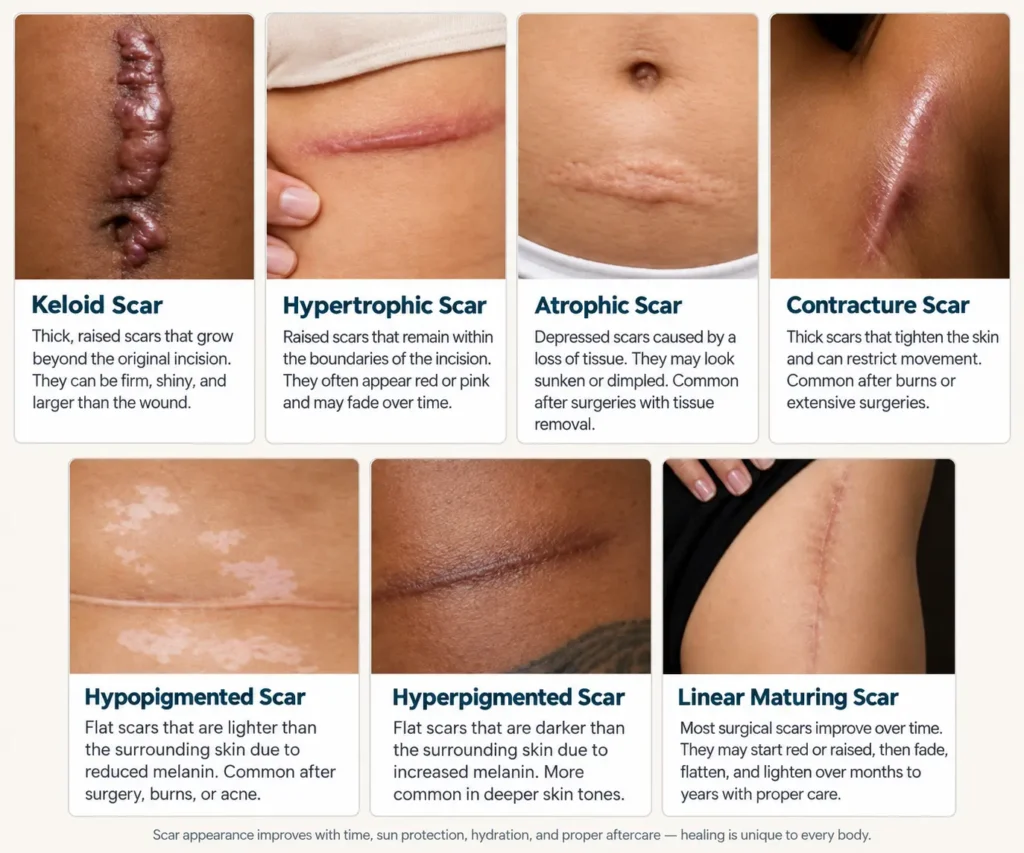
Why Does a Healed Scar Still Look Red?
New scar tissue can have a richer blood supply than ordinary skin, which contributes to its red appearance. The wound may be closed while the tissue underneath is still changing, as explained in University Hospitals Plymouth’s scar-management guidance. [5]
During remodelling, the body reorganises collagen, the protein that gives skin support. Scar tissue gradually changes in structure and may flatten as healing progresses. This later stage is separate from simply closing the wound. The review of scar mechanisms by Lin and Lai describes these stages of healing. [1]
The medical word for redness is erythema. In a scar, it describes a colour change; it does not identify the cause by itself. A clinician also considers texture, symptoms, the original injury, and the surrounding skin.
Not every scar looks bright red. Scars can appear pink, purple, brown, pale, or darker than nearby skin. Colour and texture should therefore be assessed together rather than judging healing by one shade alone. [3]
The Red Scar Healing Timeline Is Not a Fixed Deadline
Most scars become less noticeable over time, but fading is slow. NHS guidance on scars explains that this can take two years or more. That is a broad guide to scar change, not a deadline by which every red scar must turn pale. [3]
Research also shows why a rigid countdown can mislead. The review by Gauglitz and colleagues describes a study of incisional and excisional wounds in which some scars remained red at 12 months without signs of hypertrophic or keloid scarring. [2]
That finding concerns those wound types. It should not be used to predict exactly how a burn, acne mark, or recently lasered area will behave.
A scar’s direction of change matters more than a single photograph. Consider whether it is becoming softer, less prominent, and more comfortable. Persistent colour deserves assessment if it concerns you, but colour alone does not establish abnormal healing. [1,2]
You also do not need to wait for a particular anniversary before asking for help. Increasing thickness, pain, itch, or restricted movement are reasons to discuss treatment sooner. [2,6]
What Does Hypertrophic Scar Redness Mean?
A hypertrophic scar is raised and firm but stays within the original wound boundaries. It may be red and itchy while active, then gradually flatten and settle. A keloid grows beyond the original injury and generally does not regress in the same way. Understanding the difference between a keloid and a hypertrophic scar helps explain why their treatment plans may differ. [2]
Both can be red, so redness cannot distinguish them. The growth pattern and physical examination are more useful. A flat red scar is not automatically an early keloid. [2]
This distinction affects treatment. Measures used for a growing keloid should not automatically be applied to an ordinary flat surgical scar. Similarly, evidence about raised burn scars does not establish the right treatment for every red mark. [1,2]
If your scar is getting bigger, becoming thicker, or affecting movement, arrange a clinical review. Bring details of when the injury occurred and how the scar has changed.
Supporting Red Scar Healing at Home
Protect the Area From Sunlight
Cover the scar when practical and use sunscreen with SPF 30 or higher on healed, exposed skin. This supports scar care and helps protect vulnerable skin; it does not instantly remove vascular redness. [3]
Keep sunscreen off an open wound and follow any instructions provided after surgery or a skin procedure.
Use Silicone Only When Appropriate
Silicone gel or sheets may help raised scars become softer and less noticeable. The evidence discussed in the reviews chiefly concerns hypertrophic scars and scar prevention, rather than guaranteed fading of every flat red scar. [1,2]
Apply silicone only after the wound has closed, following your clinician’s or product instructions. If a sheet causes a rash or skin breakdown, stop using it and ask for advice. [6]
If your scar has been diagnosed as a keloid, our guide to silicone gel for keloids explains where silicone may fit within a broader treatment plan.
Keep Expectations for Scar Creams Realistic
A moisturiser may make a healed scar more comfortable to care for. Massage should only begin once the wound is fully healed and your care team considers it suitable. [3]
Evidence for products containing ingredients such as vitamin E or onion extract is limited. The American Academy of Dermatology’s scar-treatment guidance recommends discussing these products with a dermatologist. A product labelled for fading red scars is not proof that it will work for your scar. [6]
Which Treatments May Help Persistent Scar Redness?
Treatment should target the reason the scar remains noticeable: blood-vessel redness, raised tissue, or both. A dermatologist can assess whether continued observation or a procedure is more appropriate. [1,2,6]
Vascular Laser Treatment
Pulsed-dye laser targets small blood vessels and may improve redness in selected scars. The reviews describe its use particularly in hypertrophic scars and keloids. Those findings should not be read as a promise that every red scar will respond equally. [1,2]
Laser treatment can cause pigment changes and blistering, and more than one session may be needed. Ask about likely benefit, recovery, and the clinician’s experience treating your skin tone. The goal is improvement in colour or symptoms, not complete scar removal. [2]
For confirmed keloids, our guide to laser for keloid scars explains the different approaches and their limitations.
Treatment for Raised Tissue
Steroid injections for keloids and selected hypertrophic scars may reduce bulk, itch, or discomfort. Possible adverse effects include skin thinning and colour changes. They are not a routine treatment for a flat scar simply because it is red. [2,6]
Freezing treatment, called cryotherapy, is another option for selected raised scars. It treats scar tissue rather than ordinary healing redness and requires discussion of suitability and risks. [2,6]
Practical Patient Checklist
Before your appointment:
- Note when the wound closed and whether colour, thickness, or symptoms are changing.
- Take occasional photographs in similar lighting and at the same distance.
- Record which creams, dressings, or silicone products you use.
- Keep scar-care products off open or broken skin unless your clinician directs otherwise.
- Ask whether treatment aims to improve redness, raised tissue, discomfort, or movement.
- Seek prompt advice for spreading redness, increasing pain or warmth, swelling, or pus. [3,4]
Conclusion
Red scar healing can continue long after a wound closes. Gradual fading is common, while increasing pain, spreading redness, or discharge needs medical attention. Persistent colour and raised scar tissue require different treatment decisions. [1–4]
Book a consultation if your scar remains bothersome, is thickening, or you want advice on care suited to its stage of healing.
Read Also / See Related
- Facial scar healing — Understand care for facial wounds and scars at different stages of recovery.
- Will a scar from a burn go away? — Explore realistic expectations for burn-scar fading and improvement.
- Keloid symptoms — Learn why a raised scar may itch, hurt, or continue growing.
Sources
- [1] Lin X., Lai Y. — 2024 — Scarring Skin: Mechanisms and Therapies. International Journal of Molecular Sciences, 25(3), 1458. DOI: 10.3390/ijms25031458.
- [2] Gauglitz G.G., Korting H.C., Pavicic T., Ruzicka T., Jeschke M.G. — 2011 — Hypertrophic Scarring and Keloids: Pathomechanisms and Current and Emerging Treatment Strategies. Molecular Medicine, 17(1–2), 113–125. DOI: 10.2119/molmed.2009.00153.
- [3] NHS — Scars. Scar changes, care, and treatment.
- [4] University Hospitals Sussex NHS Foundation Trust — Identifying a wound infection. Healing signs and infection symptoms.
- [5] University Hospitals Plymouth NHS Trust — 2024 — Scar Management. Patient information on scar formation and care.
- [6] American Academy of Dermatology — Scars: Diagnosis and treatment. Scar treatment guidance.
Medical disclaimer
The information in this article is provided for general educational purposes and does not replace professional medical advice, diagnosis, or treatment. Consult a dermatologist or another qualified healthcare professional about your symptoms and treatment options. Do not disregard professional medical advice or delay seeking care because of information you have read on KeloidCare.org. Responses to keloid treatments vary, and individual results cannot be guaranteed.