

Noticing your scar getting bigger after the wound has closed can be unsettling. Healing continues beneath the surface, and some scars become thicker before settling. Others develop excess scar tissue that persists or spreads beyond the original injury. [1]
The useful distinction is how the scar is changing: becoming wider, rising above the skin, or extending into surrounding skin. These patterns help a clinician decide what may be happening and whether treatment would help.
Is Your Scar Getting Bigger Within or Beyond the Wound?
Your skin repairs an injury with collagen, a protein that gives healing tissue strength. It then gradually reorganises this material. Excess collagen production, alongside changes in how it breaks down, can create a raised scar. [1,2]
However, enlargement does not always mean a keloid. Pulling forces across a healing wound can contribute to widening as well as raised scarring. A wider scar and a growing lump therefore need different assessments. [1]
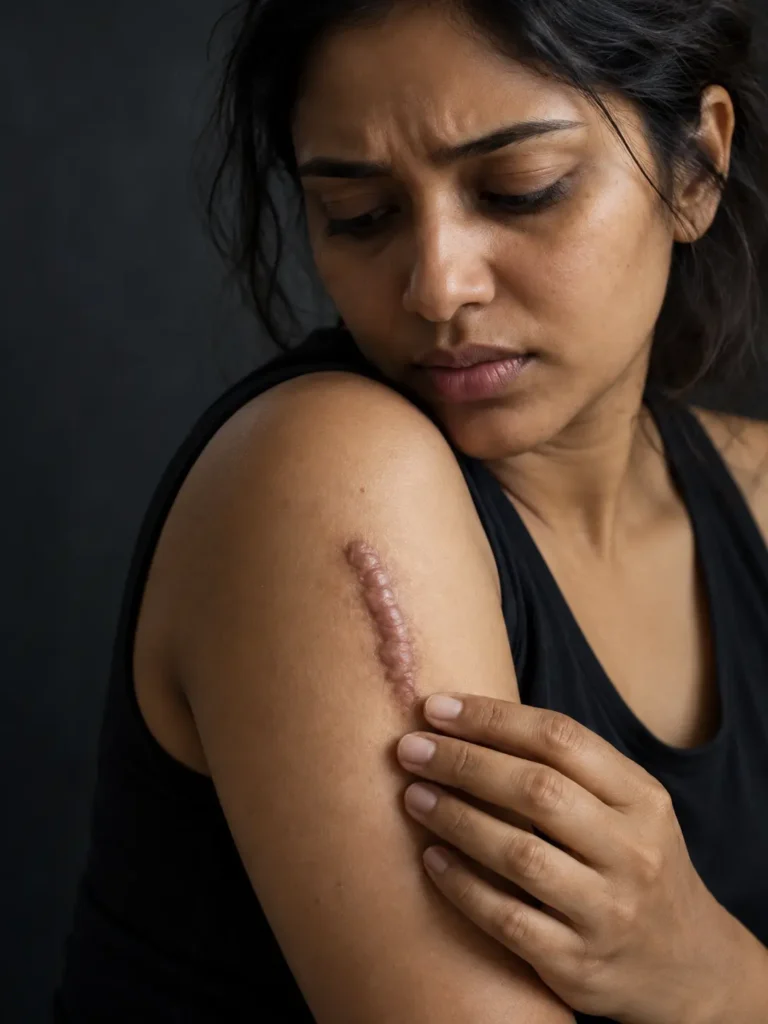
Keloid vs Hypertrophic Scar: The Boundary Matters
Both can feel firm, look raised, and itch. Their relationship to the original wound is an important distinguishing feature. The review by Gauglitz and colleagues describes these differences in excessive scarring. [1]
| Scar feature | Hypertrophic scar | Keloid |
|---|---|---|
| Growth boundary | Stays within the original wound | Extends beyond the original wound |
| When it develops | Usually during the weeks after injury | May appear months or years later |
| Longer-term behaviour | Often softens and flattens gradually | Usually persists without spontaneous flattening |
| Symptoms | May itch, hurt, or feel tight | May itch, hurt, or feel sensitive |
| Treatment implications | Natural improvement may influence timing | Recurrence prevention is especially important |
These clues cannot confirm your diagnosis at home. The distinction can be difficult, particularly when a raised scar is still developing. Our guide to keloid vs hypertrophic scar explains the differences in more detail. [1]
Colour alone is also insufficient. Scars can be pink, purple, brown, lighter, or darker than surrounding skin. [3]
Which Changes Need Medical Assessment?
A gradually thickening scar deserves an assessment, especially if it keeps expanding, affects movement, or causes persistent discomfort. You can also seek help because its appearance bothers you; pain is not a requirement. [1,3]
Seek prompt medical advice for swelling, warmth, increasing pain, or pus. These changes should not simply be attributed to scar maturation. The NHS guidance on scars advises urgent assessment for these symptoms. In the UK, contact your GP urgently or NHS 111; elsewhere, contact your clinician or local urgent-care service. [3]
A raised area may occasionally be something other than scar tissue. For example, an allergic reaction around jewellery can resemble a keloid. The American Academy of Dermatology’s diagnosis guidance explains that a dermatologist may recommend a biopsy if another condition is suspected. This involves examining a small skin sample under a microscope. [4]
Tell the clinician if the area appeared without a remembered injury, changed unexpectedly, or behaved differently from your other scars.
Why Can a Surgical Scar Get Larger Months Later?
A closed incision is not a fully matured scar. Repair cells remain active while collagen is produced and reorganised. This explains why the appearance can change after the surface looks healed. [1,2]
A surgical scar getting larger months later may reflect hypertrophic scarring, a developing keloid, or widening under tension. The timing alone cannot distinguish them. [1]
The Gauglitz review describes hypertrophic scars developing around four to eight weeks after injury, with growth continuing for up to six months. These are typical patterns, not deadlines. Keloids can develop much later. [1]
Several factors can contribute to excessive scarring:
- Tension across the wound: movement and skin pulling can influence scar formation.
- Prolonged inflammation: ongoing repair signals can encourage excess collagen production.
- Location: areas such as the chest and shoulders are particularly prone to raised scars.
- Individual susceptibility: a personal or family history of keloids matters. [1,2]
These factors are discussed in the review of scar mechanisms by Lin and Lai. They do not mean you caused the problem. Scar behaviour reflects both the injury and your skin’s response. [2]
What Does Itching Tell You About a Growing Scar?
Itching can accompany both hypertrophic scars and keloids. It does not reliably identify which type you have or show how much further it will grow. [1]
Persistent inflammation and altered repair activity are part of excessive scar formation. Research also links mechanical stress with these processes. However, the cause of an itching and growing scar cannot be determined from the sensation alone. [1,2]
At your appointment, describe whether the itch is constant, whether the scar is becoming firmer, and whether its edge has moved. Mention any new dressings or skin products, too. Our guide to keloid symptoms explores itching, pain, and growth in more detail.
If itching occurs alongside new warmth, swelling, worsening pain, or discharge, seek assessment rather than assuming it is routine healing. [3]
How to Stop a Scar From Expanding: What Can You Do?
There is no home method that reliably stops every growing scar. The first useful step is identifying the cause, particularly when tissue extends beyond the original injury.
After surgery, follow your team’s wound-care and activity instructions. Ask whether support or taping is appropriate for your incision rather than choosing it yourself. Reducing tension is an established consideration in scar prevention, but the approach must suit the wound. [1]
Silicone May Help, but It Has Limits
Medical silicone gel or sheets are commonly used for raised scars. They help retain moisture at the skin surface and may improve scar thickness or appearance. Much of the supporting discussion concerns hypertrophic scars and prevention; it should not be treated as proof that silicone will stop an established keloid. [1,2]
The American Academy of Dermatology includes silicone sheets among keloid-management options. However, recurrence remains possible after treatment. Use silicone only after the wound has healed, never over an open wound or scab. [4]
Our guide to silicone gel for keloids explains how it may fit into a broader treatment plan.
Ordinary scar creams are not interchangeable with medical silicone. The Gauglitz review found mixed evidence for onion-extract products, so they should not be presented as reliable ways to halt growth. [1]
Raised Scar Treatment Options When Growth Continues
Treatment can aim to flatten tissue, ease itching, improve movement, or reduce visibility. These are different outcomes, and none automatically means complete removal.
Before choosing a procedure, discuss the diagnosis, skin tone, scar location, previous treatments, and what improvement matters most to you.
Injections for Thickness and Discomfort
A clinician can inject corticosteroid medicine directly into a raised scar. It reduces inflammatory activity and collagen production, potentially softening or flattening tissue and easing symptoms. Repeat treatment may be needed. [1,2]
Possible effects include injection pain, thinning of the skin, visible small blood vessels, and pigment changes. A scar can regrow after improvement. [1,2]
Our guide to steroid injections for keloids explains this approach. Specialists may also use other injected medicines, such as 5-fluorouracil, which limits cell growth. It can cause skin breakdown or darkening and requires careful selection and monitoring. [2]
Freezing or Laser Treatment for Selected Scars
Cryotherapy for keloids uses controlled freezing to reduce scar tissue. It may be considered for smaller raised scars, sometimes alongside injections. Blistering, pain, and lasting pigment changes are possible, making skin colour an important part of the discussion. [1]
Selected lasers can improve raised-scar colour, thickness, or texture, but the device and treatment goal matter. Blistering and pigment changes can occur. Our guide to laser for keloid scars explains these considerations. [1]
Research on resurfacing depressed acne scars does not establish how to treat an expanding keloid. The systematic review by Bhargava and colleagues mainly evaluates atrophic acne scars—indentations associated with tissue loss. Its treatment findings should remain within that context. [5]
Surgery Requires a Recurrence Plan for Keloids
Removing a keloid creates another wound, and the tendency to form excessive scar tissue remains. It can return, sometimes larger than before. Surgery alone should therefore not be presented as a permanent cure. [1]
Specialists commonly combine keloid removal with another treatment, such as injections or pressure therapy. Radiation may be considered in selected cases, but requires an individual discussion of benefits and risks. [1,4]
Will the Scar Eventually Settle Without Treatment?
A hypertrophic scar may gradually flatten and soften, whereas a keloid usually persists. Improvement in redness or itch does not necessarily mean the raised tissue has disappeared. [1]
General scar fading can take two years or longer, according to the NHS. That timeline should not be used as a reason to ignore continued enlargement or troublesome symptoms. [3]
If observation is appropriate, ask what changes should trigger another appointment. A clear review plan is more useful than simply being told to wait.
Practical Patient Checklist
Before your appointment:
- Note when the injury occurred and when enlargement began.
- Bring earlier photographs, if available, to show changes in the edges and height.
- Record itching, pain, discharge, and any restriction of movement.
- List previous treatments and whether improvement lasted.
- Mention keloids you or close relatives have developed.
- Ask: “What type of scar is this, what can treatment realistically change, and how will we monitor recurrence?”
Conclusion
A scar getting bigger may be thickening during healing, widening under tension, or developing excess tissue. Growth beyond the original wound suggests a different pattern from thickening within it, but examination is needed to confirm the cause. [1]
If enlargement continues, arrange an assessment to discuss realistic options. Book a consultation to review the changes and decide whether monitoring or treatment suits your scar.
Read Also / See Related
- Newly formed keloid scars — Explore assessment and treatment when excess scar tissue first develops.
- Do scars get bigger with age? — Understand the difference between scar growth and changes in visibility over time.
- Keloid cancer risk — Learn why keloids are benign and why unusual changes still deserve examination.
Sources
- [1] Gauglitz G.G., Korting H.C., Pavicic T., Ruzicka T., Jeschke M.G. — 2011 — Hypertrophic Scarring and Keloids: Pathomechanisms and Current and Emerging Treatment Strategies. Molecular Medicine, 17, 113–125. DOI: 10.2119/molmed.2009.00153.
- [2] Lin X., Lai Y. — 2024 — Scarring Skin: Mechanisms and Therapies. International Journal of Molecular Sciences, 25(3), 1458. DOI: 10.3390/ijms25031458.
- [3] NHS — Scars. Patient information and assessment advice.
- [4] American Academy of Dermatology — Keloid scars: Diagnosis and treatment. Patient information on diagnosis and treatment.
- [5] Bhargava S., Cunha P.R., Lee J., Kroumpouzos G. — 2018 — Acne Scarring Management: Systematic Review and Evaluation of the Evidence. American Journal of Clinical Dermatology, 19(4), 459–477. DOI: 10.1007/s40257-018-0358-5.
Medical disclaimer
The information in this article is provided for general educational purposes and does not replace professional medical advice, diagnosis, or treatment. Consult a dermatologist or another qualified healthcare professional about your symptoms and treatment options. Do not disregard professional medical advice or delay seeking care because of information you have read on KeloidCare.org. Responses to keloid treatments vary, and individual results cannot be guaranteed.
[…] UNDERSTAND YOUR SCARWhy Is My Scar Growing? → […]
[…] UNDERSTAND YOUR SCARWhy Is My Scar Growing? → […]
[…] UNDERSTAND YOUR SCARWhy Is My Scar Growing? → […]