

CO2 laser treatment can improve depressed acne scars and some signs of sun damage, including fine facial wrinkles. However, the treatment name alone does not tell you how intensive the procedure will be or how long recovery will take. [1,2]
Before booking, you need to understand the proposed laser approach, what it can realistically change, and how your skin may respond. These eight points explain the decisions that matter.
How Does CO2 Laser Treatment Change Your Skin?
CO2 stands for carbon dioxide. This laser removes targeted skin tissue and produces heat in surrounding tissue. Healing then stimulates collagen production and remodelling. Collagen is the protein that helps give skin its structure. [1]
This is an ablative treatment, meaning it removes skin tissue. The resulting wound is controlled, but it still needs proper care.
The aim is to improve surface texture or reduce the visibility of selected scars and wrinkles. It does not replace scarred skin with completely unmarked skin. Acne-scar treatment often produces partial improvement, and results vary with scar shape and technique. [1]
Ask your clinician to describe the change they expect in your particular concern. “Smoother texture” is a clearer treatment goal than a general promise of rejuvenation.
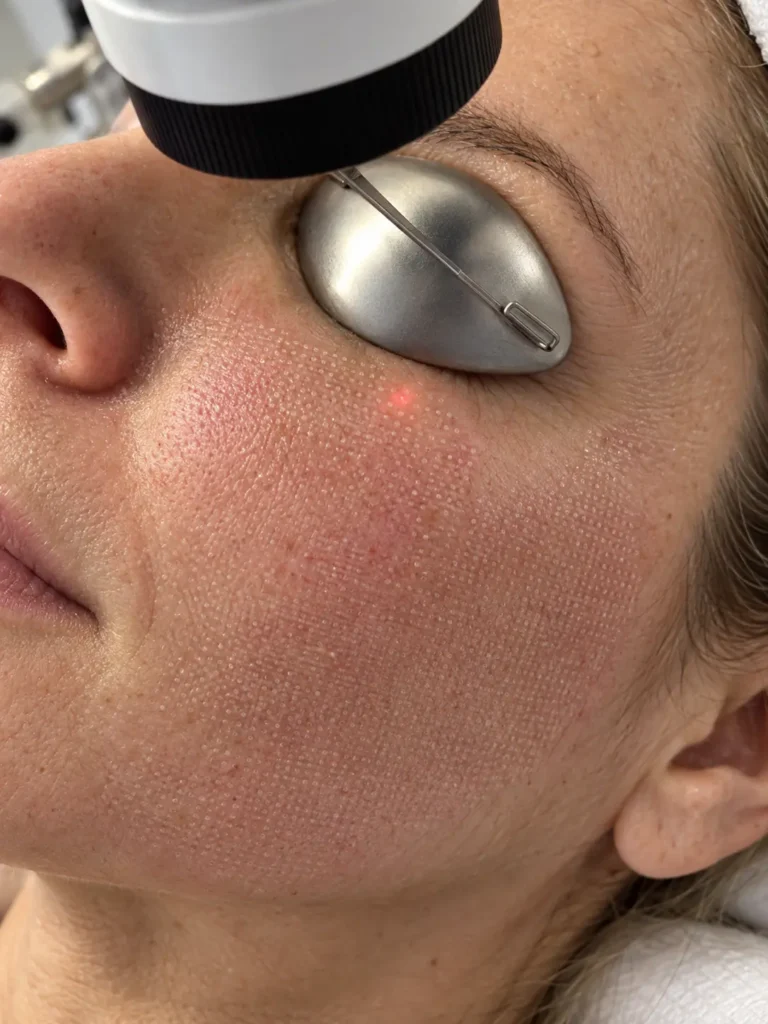
Fractional and Nonfractional Resurfacing Have Different Recovery Demands
Fractional CO2 treatment creates tiny columns of treated tissue, leaving areas between them intact. These surrounding areas support healing. Traditional nonfractional resurfacing treats a continuous area of skin. Both approaches are ablative. [1,3]
| Feature | Fractional CO2 resurfacing | Nonfractional CO2 resurfacing |
|---|---|---|
| Treatment pattern | Small columns with untreated skin between them | Continuous treatment across the selected surface |
| Healing | Generally faster, depending on settings | Generally requires more recovery |
| Treatment course | May involve several sessions | May involve a more intensive single treatment |
| Main consideration | Still carries infection, pigment, and scarring risks | More extensive injury increases recovery demands |
These distinctions are discussed in the systematic review and complications review. They do not establish that one approach is right for everyone. [1,3]
“Fractional” also describes treatment patterns used by other laser types. Results from a non-ablative fractional laser cannot automatically be applied to fractional CO2 treatment.
Ask about the device, treatment depth, and proportion of skin being treated. These details are more informative than the word “fractional” alone. [1,3]
Fine Lines and Acne Scars Need Different Treatment Plans
CO2 resurfacing can be used for fine lines and wrinkles, sun-damaged skin, and selected scars. However, facial resurfacing is not a substitute for surgery when the main concern is significant sagging. [2,4]
For acne scars, their shape matters. Atrophic scars are depressions caused by tissue loss. These differ from raised scars, which contain excess tissue. Our guide to pitted acne scar treatment explains the main patterns and why they may require different approaches. [1]
The systematic review by Bhargava and colleagues supports fractional lasers for atrophic acne scars while highlighting limitations in the evidence. It also explains why some scars need additional procedures. [1]
For example, a clinician may discuss:
- Subcision: releasing bands beneath a scar that pull it downward.
- A small surgical procedure: lifting or removing an individual deep scar.
- Resurfacing: improving the surrounding surface and softening scar edges. [1]
Deep, narrow scars may respond poorly to resurfacing alone. A combined plan should address the scars you actually have rather than add procedures automatically.
For anti-ageing goals, agree whether the priority is fine lines, texture, or uneven colour. These are separate outcomes.
Can CO2 Laser Treatment Remove Pigmentation?
CO2 resurfacing may improve some uneven colour associated with sun damage. However, a promise to “remove pigmentation” is too broad: different dark patches have different causes. [2,4]
Melasma, for example, causes patches of facial pigmentation and often returns after treatment. The British Association of Dermatologists’ melasma guidance explains that laser results are variable and treatment can worsen pigmentation or cause lighter patches. [5]
Establish the cause of dark patches before choosing a laser. If pigment is your main concern, ask whether another approach would be more appropriate.
CO2 treatment can itself trigger post-inflammatory hyperpigmentation—darkening after skin inflammation. Lighter patches can also develop. These risks need particular attention in people with darker skin tones or a history of pigment changes. [3,4]
Pigmentation treatment therefore needs a diagnosis and, in conditions such as melasma, a longer-term management plan. [5]
Your Skin History Matters Before Treatment
An assessment should cover previous healing problems, skin colour, current skin conditions, and medicines. A history of keloids or hypertrophic scars may make aggressive resurfacing unsuitable. A weakened immune system can also increase infection risk. [3]
Tell your clinician about:
- Cold sores, including outbreaks many years ago.
- Raised scars after injuries, piercings, or surgery.
- Dark marks that persist after spots or irritation.
- Active acne, skin infections, or recent tanning.
- Current and recent medicines, including isotretinoin.
- Previous facial laser treatment or surgery. [2–4]
If you have developed raised scars before, understanding the distinction between a keloid and a hypertrophic scar can help you describe your history. Your clinician should assess the diagnosis and its implications.
These details can change the procedure, preparation, or decision to proceed. They are not a reason to stop prescribed medicine yourself.
Darker skin requires careful treatment selection and a clinician experienced in discussing pigment risks and alternatives. [4]
Ask to see examples involving a similar skin tone and the same concern, with comparable lighting and follow-up.
What Happens During the Appointment—and Does It Hurt?
Pain control is part of planning. Smaller treatment areas may be managed with topical numbing medicine. More extensive treatment may require injections to numb the area or sedation. The American Society for Dermatologic Surgery’s resurfacing guidance describes preparation and pain-control options. [2]
The clinician passes the laser over the planned areas, using settings selected for the treatment goal. Afterwards, the skin may need protective ointment and dressings. Burning discomfort, swelling, and itching can occur during recovery. [2,3]
Ask what you may feel during treatment and how discomfort will be managed afterwards. If sedation is planned, arrange transport home according to your team’s instructions. [4]
Also confirm who will perform the procedure, who will review your healing, and whom you can contact outside normal clinic hours.
Recovery Involves Wound Care, Not Just Waiting for Redness to Fade
Memorial Sloan Kettering’s fractionated CO2 aftercare guidance advises that skin usually takes around one to two weeks to heal. This is a guide, not a guarantee for every device or treatment intensity. [6]
Surface healing and a return to your usual appearance are different milestones. Redness can persist after the skin closes, and prolonged redness is a recognised complication. [3]
Follow your clinician’s cleansing, ointment, and dressing instructions. Avoid picking crusts, adding unapproved products, or applying makeup before the area has healed. Protect treated skin from sunlight and ask when to introduce sunscreen. [6]
Contact your treating team promptly for increasing pain, worsening redness or swelling, fever, new blisters, or yellow or green discharge. [6]
Infection, irritation from products, and ordinary healing can sometimes look similar. Ramsdell’s review of fractional CO2 complications emphasises early recognition because infection and excessive thermal injury can lead to scarring. [3]
Before booking, plan for wound care, work commitments, and follow-up—not simply a predicted number of days indoors.
Results Develop Gradually, and Further Sessions Need a Reason
Collagen repair continues after the surface heals. Early swelling can also temporarily change how smooth the skin looks, so immediate photographs are not a reliable final result.
In a study of 60 patients by Walia and Alster, improvement and collagen remodelling were observed up to 18 months after high-energy pulsed CO2 resurfacing for atrophic facial acne scars. This was an older, uncontrolled study using nonfractional treatment. It does not predict the outcome or retreatment schedule for modern fractional devices. [7]
Fractional treatment may involve several sessions, but there is no single course suitable for every scar. The proposed schedule should reflect treatment intensity, healing, response, and the remaining concern. [1]
Ask how progress will be assessed before agreeing to additional sessions. Consistent photographs and a clear treatment goal help make that review meaningful.
Improvements may last, but ageing and further sun exposure continue. As Mayo Clinic’s laser-resurfacing guidance explains, resurfacing does not permanently prevent new lines or age-related changes. [4]
Practical Patient Checklist
Before agreeing to treatment, ask:
- What is the diagnosis: depressed scars, fine lines, sun damage, or a pigment condition?
- Why is this particular CO2 approach suitable for my skin?
- What improvement is realistic, and what is unlikely to change?
- How will you reduce my risk of pigment changes and infection?
- What wound care, recovery time, and follow-up should I plan for?
- What is included in the total price, including reviews and possible further sessions?
Bring your medication list and mention previous healing problems, cold sores, and persistent dark marks.
Conclusion
CO2 laser treatment can improve selected facial scars, fine lines, and texture, but the benefit depends on the concern being treated. Laser settings, skin history, and aftercare also influence recovery and risk. [1–3]
Before proceeding, seek a clear explanation of the expected improvement and the healing involved. Book a consultation to discuss whether facial resurfacing fits your skin and goals.
Read Also / See Related
- Facial scar healing — Understand the difference between wound closure and longer-term scar maturation.
- Red scar healing — Learn why redness may persist and which changes deserve medical assessment.
Sources
- [1] Bhargava S., Cunha P.R., Lee J., Kroumpouzos G. — 2018 — Acne Scarring Management: Systematic Review and Evaluation of the Evidence. American Journal of Clinical Dermatology, 19(4), 459–477. DOI: 10.1007/s40257-018-0358-5.
- [2] American Society for Dermatologic Surgery — Laser Resurfacing. Patient guidance.
- [3] Ramsdell W.M. — 2012 — Fractional CO2 Laser Resurfacing Complications. Seminars in Plastic Surgery, 26(3), 137–140. DOI: 10.1055/s-0032-1329415. Full article.
- [4] Mayo Clinic — Laser resurfacing. Benefits, risks, and preparation.
- [5] British Association of Dermatologists — 2024 — Melasma. Patient information leaflet.
- [6] Memorial Sloan Kettering Cancer Center — 2025 — Skin Care Before and After Fractionated Carbon Dioxide Laser Treatment. Recovery and aftercare guidance.
- [7] Walia S., Alster T.S. — 1999 — Prolonged Clinical and Histologic Effects from CO2 Laser Resurfacing of Atrophic Acne Scars. Dermatologic Surgery, 25(12), 926–930. DOI: 10.1046/j.1524-4725.1999.99115.x.
Medical disclaimer
The information in this article is provided for general educational purposes and does not replace professional medical advice, diagnosis, or treatment. Consult a dermatologist or another qualified healthcare professional about your symptoms and treatment options. Do not disregard professional medical advice or delay seeking care because of information you have read on KeloidCare.org. Responses to keloid treatments vary, and individual results cannot be guaranteed.
[…] CO2 Laser: Essential Facts […]