

The depth of an acne scar does not tell the whole story. Subcision for deep acne scars is most useful when bands of scar tissue pull the skin downward. Releasing those bands can lift a depression, especially a rolling scar. A deep, narrow ice pick scar usually needs a different approach. [1,2]
Understanding what holds your scars down helps explain why subcision may be recommended—and why it may be only part of your treatment.
When Does Subcision for Deep Acne Scars Make Sense?
Subcision treats a structural problem beneath the skin. A clinician passes a needle or cannula, a slender tube, under a depressed scar. The instrument releases fibrous bands that anchor the scar to deeper tissue. Healing can also stimulate collagen, the protein that supports skin. [1,2]
This makes it different from removing the scar or treating its surface. The aim is to reduce the depth of a tethered depression, not erase every sign of scarring.
A consultation should establish whether tethering is an important part of your scars. Scar depth alone is not enough to choose the procedure. Shape, location, skin tone, previous treatment, and your expectations also matter. [1,3]
Our guide to pitted acne scar treatment explains why different types of depressions may need different methods.
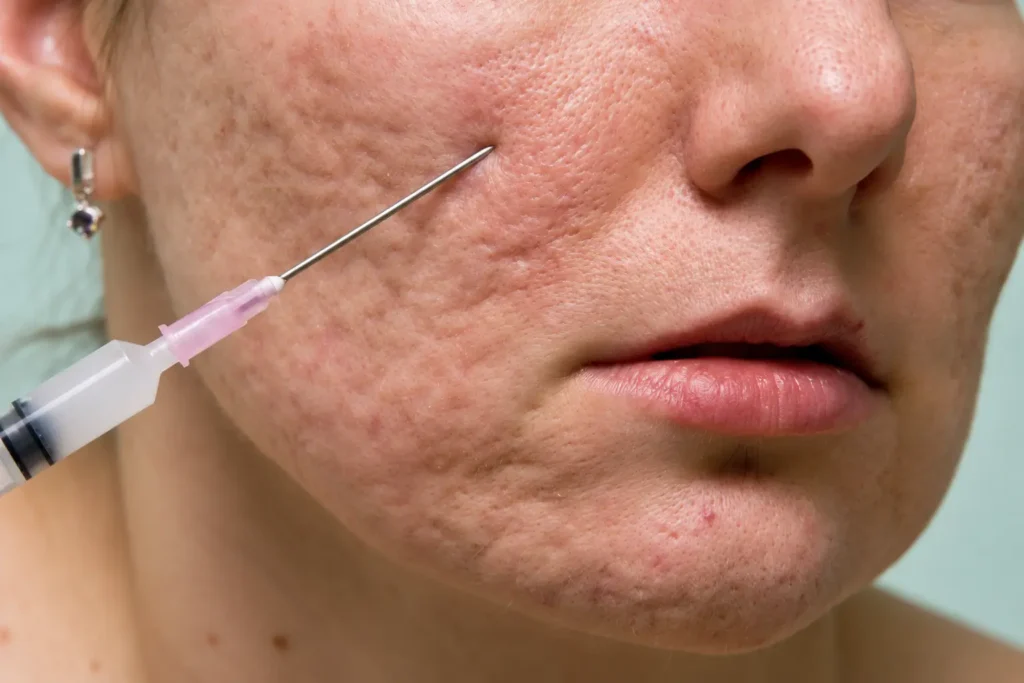
Subcision for Rolling and Boxcar Scars
Rolling scars create broad dips and an uneven, wavy surface. Their underlying attachments make them a particularly suitable target. Boxcar scars have more distinct edges; some have tethering, but they generally respond less well to subcision alone than rolling scars. [1,2]
| What the scar looks like | How subcision may help | What it may leave untreated |
|---|---|---|
| Broad, tethered rolling depression | Releases bands pulling the skin downward | Remaining texture or loss of volume |
| Boxcar depression with tethering | May release an attached scar base | Sharp edges and some deep structural changes |
| Narrow, deep ice pick pit | Usually has a limited role | The deep tract, which may need clinician-performed focal acid treatment or punch excision |
This comparison reflects scar-specific findings in the systematic review by Bhargava and colleagues and the acne-scarring treatment review by Connolly and colleagues. Many people have mixed scars, so different areas may need different methods. [1,2]
Subcision vs Laser for Deep Acne Scars
Subcision and laser treatment address different features. Subcision releases attachments below a scar. Laser resurfacing encourages skin remodelling and can improve surface texture and scar edges. [1]
Fractional lasers treat small columns of skin while leaving tissue between them untreated. Ablative versions, such as fractional CO₂ laser treatment, remove tissue within those columns. Non-ablative versions heat tissue without removing the surface in the same way. [1]
If strong tethering is the main problem, surface treatment alone may leave the depression behind. After release, laser treatment may help remaining unevenness. Conversely, scars without meaningful tethering may have little to gain from subcision. [1,2]
Neither procedure is universally better. The evidence includes different devices, scar patterns, and treatment combinations, making blanket comparisons unreliable. Ask which feature each proposed procedure is intended to change.
Laser also brings separate risks, including pigment changes, infection, and additional scarring. Combining procedures therefore needs an individual plan rather than an assumption that more treatment always produces a better result. [1]
Why Combine Subcision and Dermal Fillers for Acne Scars?
Releasing an attachment does not always replace lost volume. A filler can add support beneath selected depressed scars after subcision. The systematic review describes fillers as useful particularly for suitable rolling and boxcar scars. [1]
Hyaluronic acid is one option. Its effects are temporary, and further treatment may be needed as the material is absorbed. Different fillers have different properties, so ask for the product name, expected duration, and reason for choosing it. [1]
Filler is not essential for every subcision procedure. Ask what additional improvement is expected and whether reassessing after healing is an option. A treatment package should reflect your scars and priorities.
Fillers add their own risks, including swelling, bruising, infection, and lumps. Rare accidental injection into a blood vessel can cause tissue death, blindness, or stroke. The FDA’s dermal filler guidance explains these risks and why product-specific counselling matters. [4]
What Happens Before and During the Appointment?
Your clinician should examine your scars and review your health and treatment history. Mention bleeding problems, medicines, previous procedures, and any tendency to develop raised scars. These can affect suitability and planning. [3]
If you still have acne, controlling breakouts usually comes first. The American Academy of Dermatology’s acne-scar treatment guide explains that preventing new breakouts helps prevent additional scars. [5]
Tell the clinician about current and recent acne medicines, including isotretinoin, so treatment timing can be assessed individually. Do not stop prescribed medicines without medical advice.
The procedure usually involves cleaning the skin, marking the scars, and injecting local anaesthetic to numb the area. The clinician then works beneath selected scars through small entry points. Afterwards, pressure may be applied to control bleeding. [3]
DermNet’s subcision overview describes the procedure and suitability considerations. Ask about the planned treatment area and instrument: a needle or cannula is a tool choice, not a guarantee of a particular result. Clinician experience and careful assessment remain important. [1,3]
Subcision Recovery Time and Side Effects
Plan for visible bruising and swelling rather than assuming you will look unchanged afterwards. Tenderness and bleeding can also occur. The reviewed evidence does not establish one recovery time that applies to every technique or treatment area. [1,2]
Ask your clinician to distinguish time off work from time until bruising settles and time until results can be assessed. These are different milestones. Added filler or laser treatment may also change the aftercare plan.
Possible complications include infection, a collection of blood under the skin called a haematoma, pigment changes, and new raised scars. Nerve or blood-vessel injury is also possible, which makes knowledge of facial anatomy important. [3]
Follow the clinic’s instructions about cleaning, sun protection, exercise, and when to restart skin products. Ask before massaging or using suction on the treated area; aftercare should match the technique used.
Contact your clinician promptly for worsening pain, spreading redness, discharge, or concerning swelling. If filler was also injected, unusual pain, pale or dusky skin, or any vision change needs immediate medical attention. [4]
How Lasting Are the Results, and What Should Photos Show?
Subcision for deep acne scars can produce worthwhile improvement, but repeat sessions may be needed. A depression can persist or recur, and improvement does not mean the skin has become scar-free. [1,2]
This matters when viewing before-and-after photographs. Ask whether the result followed subcision alone or whether filler, laser, or another treatment also contributed. Combination results cannot show the effect of subcision by itself.
Look for matched lighting, angle, facial expression, and camera distance. Ask how long after treatment the final photograph was taken. Early swelling can temporarily make depressions look shallower, so an immediate photograph is not a reliable measure of the settled result.
Research supports subcision for appropriately selected scars, but studies differ in their methods and assessments. A fixed percentage improvement cannot reliably predict your outcome. Agree on a review point and a realistic goal before treatment begins. [1,2]
Practical Patient Checklist
Before your appointment:
- Ask which scars are tethered and which need another approach.
- Clarify whether the plan is subcision alone or a combination, and why.
- Disclose medicines, bleeding problems, active acne, and previous abnormal scarring. [3,5]
- Request written aftercare instructions and a contact for recovery concerns.
- Discuss total costs, possible repeat sessions, and what happens if improvement is limited.
- Request photographs under consistent conditions and a planned review after healing.
Conclusion
Subcision for deep acne scars can be useful when tethering pulls the skin downward, especially in rolling scars. It is less suited to narrow ice pick scars, and mixed scarring may need additional treatment. Improvement is possible, but complete removal and permanent correction are not guaranteed. [1,2]
Book a consultation to find out whether your scars are tethered and discuss a plan that matches your goals.
Read Also / See Related
- Facial scar healing — Understand the difference between wound closure and longer-term scar maturation.
- Red scar healing — Explore persistent scar redness, which is a different concern from a tethered depression.
Sources
- [1] Bhargava S., Cunha P.R., Lee J., Kroumpouzos G. — 2018 — Acne Scarring Management: Systematic Review and Evaluation of the Evidence. American Journal of Clinical Dermatology, 19(4), 459–477. DOI: 10.1007/s40257-018-0358-5.
- [2] Connolly D., Vu H.L., Mariwalla K., Saedi N. — 2017 — Acne Scarring—Pathogenesis, Evaluation, and Treatment Options. Journal of Clinical and Aesthetic Dermatology, 10(9), 12–23. Full article.
- [3] Logan I.; chief editor Oakley A. — 2015 — Subcision. DermNet. Procedure overview, suitability, and complications.
- [4] US Food and Drug Administration — Dermal Fillers (Soft Tissue Fillers). Patient information and safety guidance.
- [5] American Academy of Dermatology — Acne scars: Consultation and treatment. Patient treatment guide.
Medical disclaimer
The information in this article is provided for general educational purposes and does not replace professional medical advice, diagnosis, or treatment. Consult a dermatologist or another qualified healthcare professional about your symptoms and treatment options. Do not disregard professional medical advice or delay seeking care because of information you have read on KeloidCare.org. Responses to keloid treatments vary, and individual results cannot be guaranteed.