

An itchy or painful keloid can be difficult to ignore, especially when clothing touches it or it seems to be getting bigger. These keloid symptoms are recognised features of excessive scar formation. They deserve attention even if appearance is not your main concern. [1]
The aim of care may be less itching, easier movement, slower growth, or a flatter scar. These are different goals, and improvement in one does not guarantee improvement in all of them.
Quick Answer
Common keloid symptoms include itching, pain, firmness, and growth beyond the original wound. Inflammatory signals and altered nerve function may contribute to discomfort. Symptoms can occur while the scar enlarges, but itching alone does not prove growth. Sudden worsening pain, spreading redness, warmth, or discharge needs prompt assessment. [1–4]
Why Can a Keloid Itch or Feel Painful?
A keloid is an overgrowth of scar tissue that extends beyond the original wound. Unlike an ordinary scar that gradually settles, a keloid can persist and continue enlarging. The tissue contains excess collagen, the protein that gives skin support. [1]
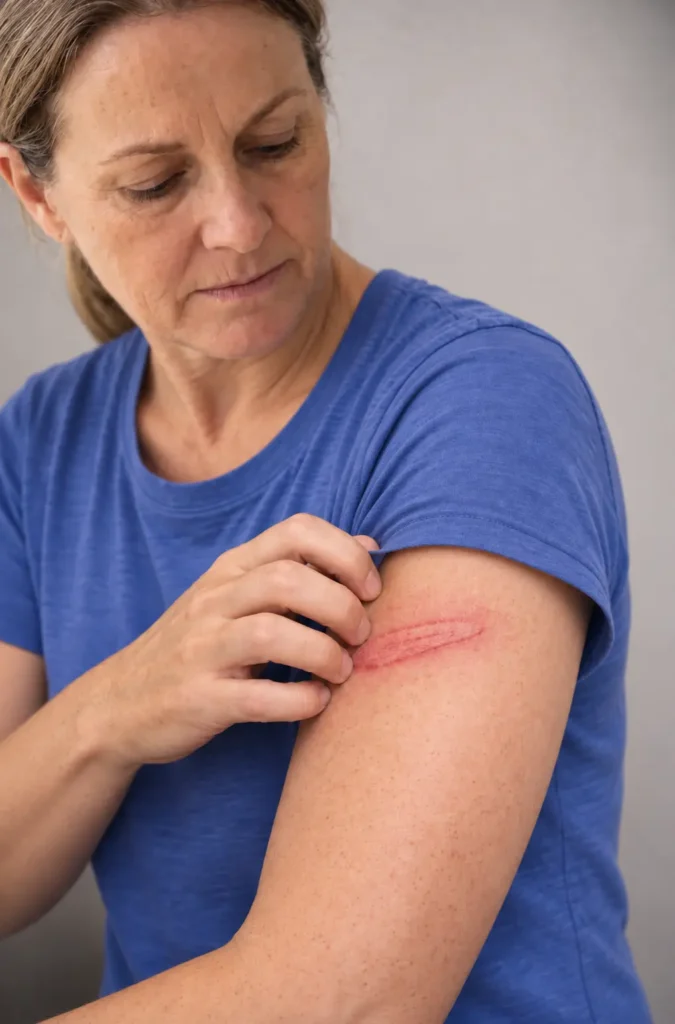
Itching Involves More Than the Skin Surface
Cells involved in inflammation release chemical signals within scar tissue. The review by Gauglitz and colleagues discusses how mast cells, a type of immune cell, may contribute to itching through substances such as histamine. [1]
This does not mean every itchy keloid is caused by an allergy. It also does not establish that an antihistamine will control every person’s symptoms. The biology of keloid discomfort is more complex than a single chemical signal. [1,2]
Nerve Sensitivity May Contribute to Pain
Altered sensation is one possible explanation for painful keloids. A controlled study of small nerve fibre function found sensory abnormalities in keloids, supporting a possible nerve-related contribution to pain and itch. [2]
That finding does not explain every painful scar or diagnose the cause of your pain. New discomfort may also require assessment for irritation, a reaction to a product, or infection. A lump assumed to be a keloid can occasionally be another skin condition. [4,5]
Tell your clinician whether the sensation is itching, tenderness, burning, or sharp pain. Also explain whether it happens at rest, with touch, or during movement. These details are more useful than describing the scar only as “active”.
Does Itching Mean a Keloid Is Growing?
Itching and pain often occur while a keloid is growing. NHS guidance on keloid scars notes that growth may continue for months or years and that discomfort often settles when growth stops. [3]
However, itch is not a reliable measurement of growth. If you notice a scar getting bigger, compare its height, width, and outer edge over time. Photographs taken in consistent lighting can help you explain changes at an appointment.
An “active keloid scar” is a descriptive phrase rather than a diagnosis you can confirm from one symptom. Increasing size and persistent symptoms support arranging a review; they do not tell you which treatment will work best.
It is also important to understand the difference between a keloid and a hypertrophic scar. A hypertrophic scar stays within the original wound and may gradually flatten. A keloid extends beyond that boundary and does not usually regress in the same way. [1]
Advice based only on raised burn scars or ordinary surgical scars may therefore not apply to a true keloid.
Which Keloid Symptoms Need Prompt Medical Attention?
A familiar itch is different from a sudden change in pain or the surrounding skin. Do not assume every new symptom is simply the keloid growing.
| Pattern | What it may mean | What to do |
|---|---|---|
| Longstanding itch or tenderness without a sudden change | Recognised keloid symptoms | Arrange a routine review if bothersome. |
| Gradual enlargement beyond the original wound | Ongoing keloid growth | Discuss assessment and treatment. |
| Increasing warmth, spreading redness, swelling, or discharge | Possible infection or another complication | Seek prompt medical advice. |
| A new or unusual lump that has not been diagnosed | It may not be a keloid | Have it examined before treating it. |
These are assessment prompts, not a way to diagnose the problem at home. [1,3–5]
The University Hospitals Sussex guide to wound infection explains warning signs such as increasing pain, heat, swelling, and fluid leaking from a wound. This is particularly relevant if the scar has broken skin or was recently treated. [4]
For suspected infection, contact your treating team, GP, or urgent care. In the UK, NHS 111 can advise when your usual service is unavailable. Severe illness with confusion, breathing difficulty, or collapse requires emergency help. [4]
Itchy Keloid Relief: What Can You Try at Home?
For intact skin, a cool, damp cloth and a fragrance-free moisturiser may help soothe itching. Loose, soft clothing can reduce irritation from rubbing. These measures come from general itch-care guidance from the American Academy of Dermatology; they have not been established as ways to stop keloid growth. [6]
Avoid scratching or repeatedly rubbing the area. If a product stings or makes the skin more irritated, stop using it and ask for advice. Tell your clinician if discomfort began after a new cream, dressing, or treatment.
Where Silicone Fits
Silicone gel and sheets may be included in a keloid treatment plan, particularly for newer scars or after another treatment. They should be used only after the skin has healed, never over an open wound or scab. [5]
Expectations matter: the review by Gauglitz and colleagues discusses stronger evidence for silicone in hypertrophic scars than in established keloids. Silicone should not be presented as a guaranteed way to flatten an old keloid or eliminate pain. [1]
If itch affects sleep, concentration, or daily activities, ask for a tailored symptom plan. The American Academy of Dermatology’s keloid treatment guide specifically recognises relief of pain and itch as treatment goals. [5]
How Can Treatment Address Keloid Symptoms and Growth?
Keloid scar treatment should be chosen after confirming the diagnosis. Scar size, location, skin tone, previous treatment, and your priorities influence the plan. Several methods may be combined because no single treatment reliably suits every keloid. [1,5]
Corticosteroid Injections
Keloid steroid injections place medicine directly into the scar to reduce inflammation and excessive scar activity. They may soften or flatten the keloid and ease symptoms. A course of treatment is often needed. [1,5]
Injections can hurt and may cause thinning skin, visible small blood vessels, or colour changes. A clinician should discuss these risks, particularly when treating visible areas. Improvement does not rule out later regrowth. [1,5]
Freezing or Laser Treatment
Cryotherapy for keloids freezes scar tissue and may reduce the size of selected keloids, especially smaller lesions. It can cause pain, blistering, and pigment changes, including permanent lightening. The balance of benefit and risk needs particular care in darker skin. [1]
Pulsed-dye laser targets blood vessels and may improve selected keloid features, including colour. Laser treatment for keloid scars is often considered alongside other treatments. Blistering and pigment changes are possible, and results vary. [1]
Ask which outcome each procedure is intended to improve. A less red scar may remain raised; a softer scar may still need symptom treatment.
Will Removing the Keloid Stop It Coming Back?
Surgical keloid removal alone does not reliably cure a keloid. It creates another wound, and the keloid may return, sometimes larger than before. The review by Gauglitz and colleagues therefore cautions against excision without an additional treatment plan. [1]
When surgery is appropriate, a specialist may recommend measures such as injections, prescribed pressure treatment, or carefully selected postoperative radiotherapy. These require individual assessment; they are not interchangeable options for every patient. [1,5]
Radiotherapy has additional risks, including skin changes and potential long-term radiation effects, which require a specialist discussion. [1]
Ask how recurrence will be monitored and what to do if thickening or symptoms return. Long-term management may involve adjusting treatment rather than repeating the same procedure automatically.
Practical Patient Checklist
Before your appointment:
- Record whether itch, pain, growth, or restricted movement bothers you most.
- Note when symptoms occur and whether clothing or products aggravate them.
- Bring photographs showing changes in the scar’s border and thickness.
- List previous treatments, benefits, and side effects.
- Ask how treatment success will be judged beyond appearance alone.
- Request a plan for aftercare, recurrence, and symptoms that need urgent advice.
Conclusion
Keloid symptoms can reflect ongoing scar activity and altered sensitivity, but new or worsening changes should not be dismissed. Treatment may ease itching and pain or reduce growth, even when complete removal is not possible. Recurrence remains part of treatment planning. [1,2,5]
Book a consultation to discuss your symptoms and agree on goals that matter to you. Seek prompt medical advice if pain suddenly worsens or you develop spreading redness, warmth, swelling, or discharge.
Read Also / See Related
- Newly formed keloid scars — Learn about assessment and treatment when a raised scar first develops.
- Keloids on the ear — Explore piercing-related keloids and treatment considerations for this location.
- Keloid cancer risk — Understand why keloids are benign and which unusual scar changes still deserve assessment.
Sources
- [1] Gauglitz G.G., Korting H.C., Pavicic T., Ruzicka T., Jeschke M.G. — 2011 — Hypertrophic Scarring and Keloids: Pathomechanisms and Current and Emerging Treatment Strategies. Molecular Medicine, 17(1–2), 113–125. DOI: 10.2119/molmed.2009.00153.
- [2] Lee S.S., Yosipovitch G., Chan Y.H., Goh C.L. — 2004 — Pruritus, pain, and small nerve fiber function in keloids: a controlled study. Journal of the American Academy of Dermatology, 51(6), 1002–1006. PubMed abstract.
- [3] NHS — Keloid scars. Symptoms, growth, and treatment.
- [4] University Hospitals Sussex NHS Foundation Trust — Identifying a wound infection. Infection symptoms and when to seek help.
- [5] American Academy of Dermatology — Keloid scars: Diagnosis and treatment. Patient treatment guide.
- [6] American Academy of Dermatology — 2024 — Stop itchy skin in its tracks. General itch-care guidance, used here for comfort measures rather than evidence of keloid growth control. Itch relief advice.
Medical disclaimer
The information in this article is provided for general educational purposes and does not replace professional medical advice, diagnosis, or treatment. Consult a dermatologist or another qualified healthcare professional about your symptoms and treatment options. Do not disregard professional medical advice or delay seeking care because of information you have read on KeloidCare.org. Responses to keloid treatments vary, and individual results cannot be guaranteed.
[…] UNDERSTAND KELOIDSSigns & Symptoms → […]
[…] UNDERSTAND KELOIDSSigns & Symptoms → […]
[…] UNDERSTAND KELOIDSSigns & Symptoms → […]
[…] UNDERSTAND KELOIDSSigns & Symptoms → […]