
Keloid scar treatment aims to reduce scar thickness, ease symptoms, and improve appearance while limiting recurrence. Options include corticosteroid injections, silicone products, cryotherapy, laser procedures, and surgery combined with additional treatment.
There is no single approach that works for everyone. The most suitable plan depends on the scar’s size, location, symptoms, previous treatment, and your priorities. Understanding the benefits and limitations of each option can help you make an informed decision.
What Are Keloid Scars?
Keloids develop when scar tissue grows beyond the boundaries of the original skin injury. Unlike hypertrophic scars, which remain within the wound’s borders, keloids can extend into surrounding skin and tend to persist.
They may develop after surgery, piercings, burns, acne, or other injuries. Their appearance varies: a keloid may be pink, red, purple, brown, or close to the surrounding skin color. Not every keloid is painful or itchy.
The American Academy of Dermatology’s keloid overview explains how these scars differ from other forms of scarring.
Causes and Risk Factors
Keloid formation reflects an excessive wound-healing response. A personal or family history of keloids can indicate a greater risk of developing another one after skin injury.
If you have previously developed a keloid, discuss this before elective surgery, tattooing, or piercing. Treating acne and avoiding unnecessary skin trauma may help reduce opportunities for new scars to form. These precautions reduce risk but cannot guarantee prevention. American Academy of Dermatology: Keloid self-care
Symptoms of Keloids
Common features include:
- Raised, thickened scar tissue.
- Growth beyond the original injury.
- Itching, tenderness, or pain.
- Changes in color compared with surrounding skin.
- Restricted movement when a scar affects a joint.
Our guide to keloid symptoms explores these features in more detail. A clinician should assess an uncertain diagnosis, because other skin conditions can resemble a keloid. American Academy of Dermatology: Diagnosis and treatment
Choosing a Keloid Scar Treatment
A useful treatment plan begins with a clear goal. You may want to relieve itching, reduce bulk, improve movement, or make the scar less noticeable. Complete removal without recurrence is not always achievable.
Ekstein and colleagues describe keloid management as an individualized, often multimodal process. Combining treatments may improve outcomes, but no approach consistently prevents recurrence in every patient.
Steroid Injections for Keloids
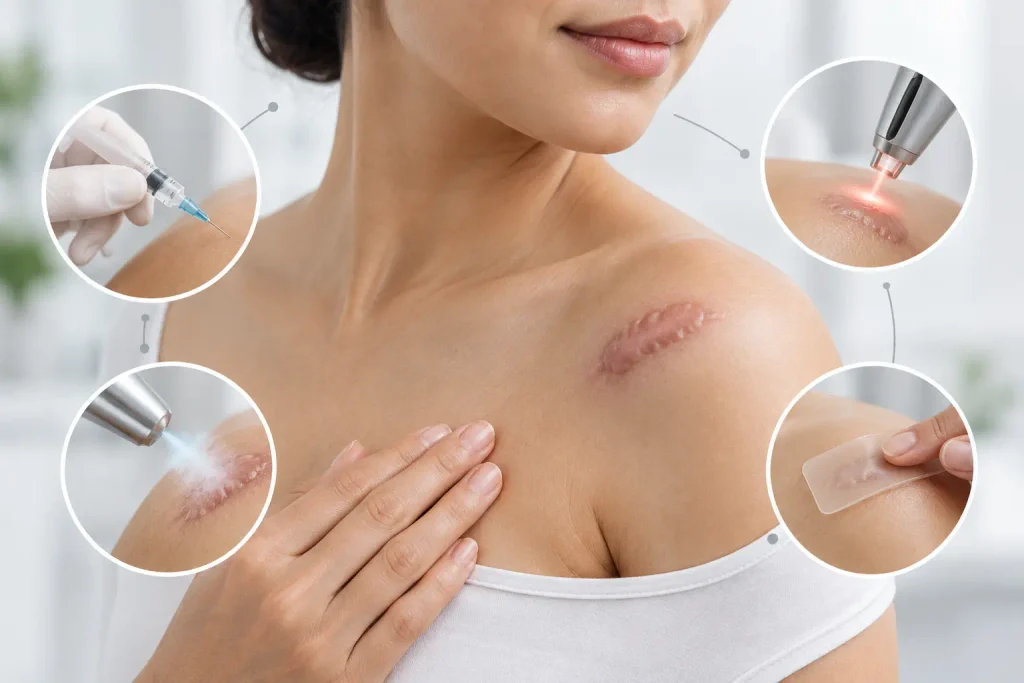
Corticosteroid injections are a commonly used first-line treatment. The medicine is injected into the scar to reduce inflammation and excessive scar-tissue activity, helping it become flatter and softer.
Triamcinolone acetonide, often abbreviated as TAC, is frequently used. Walsh et al. (2023) describe concentrations of 10–40 mg/mL in clinical practice and research. However, concentration, injected volume, treatment intervals, and the number of sessions vary. The review does not establish one universal schedule for every scar.
Injections can be uncomfortable. Possible adverse effects include skin thinning, visible small blood vessels, and pigment changes. Your clinician should review both the response and side effects before continuing treatment.
Combining Steroid Injections With 5-Fluorouracil
Some treatment plans combine TAC with 5-fluorouracil, or 5-FU, which interferes with the activity of cells involved in excessive scar formation.
A systematic review and meta-analysis by Ren and colleagues found that combination treatment may offer better outcomes and fewer reported complications than TAC alone. However, the included research covered both keloids and hypertrophic scars, which limits how precisely the findings apply to an individual keloid.
Combination injections still have risks, and their use should be discussed with an experienced clinician.
Silicone Sheets and Gel
Silicone sheets and silicone gel for keloids are non-invasive options used in scar care. They help maintain hydration over healed skin and may be included alongside other treatments.
Their widespread use should not be confused with strong evidence that they reliably flatten established keloids. A 2023 Cochrane review found very low-certainty evidence and could not establish whether silicone sheets were more effective than the comparison treatments studied.
Use silicone products according to their instructions and your clinician’s advice. Do not apply them over an open wound or scab. American Academy of Dermatology
Cryotherapy for Keloid Scars
Cryotherapy for keloids uses extreme cold to damage scar tissue. It may reduce the size and hardness of smaller keloids and can be combined with injections.
Surface freezing and intralesional freezing are different techniques. The latter treats the scar from within using a specialized probe. Pain, blistering, and pigment changes are possible; lightening of the skin can be permanent, particularly in darker skin tones. American Academy of Dermatology
Laser Treatment
Laser treatment for keloid scars may help address selected features, such as redness, thickness, or symptoms. Different lasers have different purposes, so “laser removal” does not describe a single standardized procedure.
Laser treatment is often combined with other approaches, including corticosteroids. Ekstein et al. discuss these combinations while emphasizing that outcomes and recurrence remain variable.
Surgery and Recurrence Prevention
Surgery may be considered for selected large or resistant keloids, but removal alone carries a substantial risk of regrowth. A postoperative plan is therefore an important part of the decision.
Ogawa and colleagues’ NMS protocol describes a specialist approach involving treatment selection, tension-reducing surgical techniques, and additional therapies such as postoperative radiotherapy and corticosteroid tape or plaster where appropriate.
This protocol supports coordinated treatment rather than a universal operation for every scar. Radiotherapy requires specialist assessment and a discussion of its benefits, risks, and suitability.
Do Keloid Removal Creams Work?
The phrase “keloid removal cream” can create unrealistic expectations. Products containing onion extract or vitamin E have limited supporting research and should not be presented as proven ways to remove an established keloid.
The American Academy of Dermatology’s scar-treatment guidance recommends discussing these products with a dermatologist. Prescription topical treatments are a separate category and may have a role in selected treatment plans.
Can You Flatten Keloids Naturally?
Apple cider vinegar, tea tree oil, moisturizers, and massage should not be presented as established methods for removing keloids. There is insufficient reliable clinical evidence to recommend household remedies as substitutes for medical treatment.
A moisturizer may help dry skin feel more comfortable, but comfort and scar flattening are different outcomes. Avoid aggressive rubbing or applying products that cause burning or irritation.
For care at home, focus on following the agreed treatment plan, protecting the area from unnecessary trauma, and using sun protection after healing. These measures support skin care but do not guarantee that a keloid will shrink. American Academy of Dermatology: Keloid self-care
What to Expect From Treatment
Keloid scar treatment may require several appointments and follow-up after an initial improvement. Photographs taken under similar lighting and notes about itching, pain, or movement can help you discuss progress with your clinician. The time needed to see improvement with keloid scar treatment varies depending on the scar and the approach used.
Before starting, ask:
- Which changes are realistic for this scar?
- How will we decide whether treatment is working?
- What are the risks for my skin tone?
- How much recovery time might be needed?
- What is the plan if the scar returns?
Conclusion
An effective keloid scar treatment plan balances symptom relief, appearance, side effects, and recurrence risk. Steroid injections are commonly used, while silicone products, cryotherapy, lasers, and surgery have roles in selected cases.
If a scar is growing, uncomfortable, or affecting your confidence, book a consultation to confirm the diagnosis and discuss an individualized treatment plan.
Read Also / See Related
- Keloid vs. hypertrophic scar — Understand how these raised scars differ and why the diagnosis matters when choosing treatment.
- Cryotherapy for keloids — Explore freezing treatments, potential side effects, and their role in a combined treatment plan.
- Newly formed keloid scars — Learn what to consider when a scar first becomes raised or starts growing beyond the original injury.
References
- American Academy of Dermatology Association. Keloid scars: Overview. Available at: https://www.aad.org/public/diseases/a-z/keloids-overview.
- American Academy of Dermatology Association. Keloid scars: Self-care. Available at: https://www.aad.org/public/diseases/a-z/keloids-self-care.
- American Academy of Dermatology Association. Keloid scars: Diagnosis and treatment. Available at: https://www.aad.org/public/diseases/a-z/keloids-treatment.
- Ekstein SF, Wyles SP, Moran SL, Meves A. Keloids: a review of therapeutic management. International Journal of Dermatology. 2021;60(6):661–671. Published online September 9, 2020. doi: 10.1111/ijd.15159.
- Walsh LA, Wu E, Pontes D, et al. Keloid treatments: an evidence-based systematic review of recent advances. Systematic Reviews. 2023;12:42. doi: 10.1186/s13643-023-02192-7.
- Ren Y, Zhou X, Wei Z, et al. Efficacy and safety of triamcinolone acetonide alone and in combination with 5-fluorouracil for treating hypertrophic scars and keloids: a systematic review and meta-analysis. International Wound Journal. 2017. doi: 10.1111/iwj.12629.
- Tian F, Jiang Q, Chen J, Liu Z. Silicone gel sheeting for treating keloid scars. Cochrane Database of Systematic Reviews. 2023;1. doi: 10.1002/14651858.CD013878.pub2.
- Ogawa R, Dohi T, Tosa M, Aoki M, Akaishi S. The latest strategy for keloid and hypertrophic scar prevention and treatment: The Nippon Medical School (NMS) protocol. Journal of Nippon Medical School. 2021;88(1):2–9. doi: 10.1272/jnms.JNMS.2021_88-106.
- American Academy of Dermatology Association. Scars: Diagnosis and treatment. Available at: https://www.aad.org/public/diseases/a-z/scars-treatment.
Medical disclaimer
The information in this article is provided for general educational purposes and does not replace professional medical advice, diagnosis, or treatment. Consult a dermatologist or another qualified healthcare professional about your symptoms and treatment options. Do not disregard professional medical advice or delay seeking care because of information you have read on KeloidCare.org. Responses to keloid treatments vary, and individual results cannot be guaranteed.
[…] EXPLORE YOUR OPTIONSTreatment Overview → […]
[…] EXPLORE YOUR OPTIONSTreatment Overview → […]