

Keloids are raised scars that can develop after a skin injury and grow beyond the original wound. They are more common in people with darker skin tones and may cause both cosmetic concerns and physical discomfort.
The most appropriate keloid removal approach depends on the scar’s size, location, symptoms, and previous treatment history. Although treatment can improve appearance and comfort, removing a keloid does not guarantee that it will never return.
What Are Keloids?
Keloids result from excessive scar-tissue formation during wound healing. Unlike hypertrophic scars, which remain within the original wound boundaries, keloids extend into surrounding skin and can continue growing.
Common keloid symptoms include itching, tenderness, and a firm, raised texture. Understanding the diagnosis is an important first step before choosing a treatment. Limandjaja et al. (2020)
Evidence-Based Keloid Removal Techniques
Keloid Surgical Excision
Surgical excision of keloids involves surgically removing scar tissue. It may be considered for selected large, troublesome, or treatment-resistant lesions.
According to Ekstein et al. (2021), recurrence remains a major challenge, making additional treatment an important consideration after surgery.
Limandjaja et al. (2020) report recurrence rates of 55–100% after excision alone in the literature they reviewed. This range is not an individual prediction, but it illustrates why surgery should be discussed alongside a recurrence-prevention plan.
For many patients, surgical excision is therefore one part of a broader keloid removal strategy.
5-Fluorouracil and Steroid Injections
5-Fluorouracil, or 5-FU, is an antimetabolite medicine also used in cancer treatment. When injected into a keloid, it targets cells involved in excessive scar formation. Its use does not mean that the scar is cancerous.
A systematic review by Ren et al. (2017) found that combining 5-FU with triamcinolone acetonide, or TAC, may improve treatment outcomes and reduce some complications compared with TAC alone. The review included both keloids and hypertrophic scars, so its findings should be interpreted with that limitation in mind.
Searle, Al-Niaimi, and Ali (2021) also review the use of 5-FU for noncancerous skin conditions, including keloid and hypertrophic scarring.
Combination treatment is not free of side effects. Injection pain, pigment changes, and skin ulceration can occur. Our guide to steroid injections for keloids explains the corticosteroid component in more detail. Ekstein et al.
Pressure Therapy for Keloids
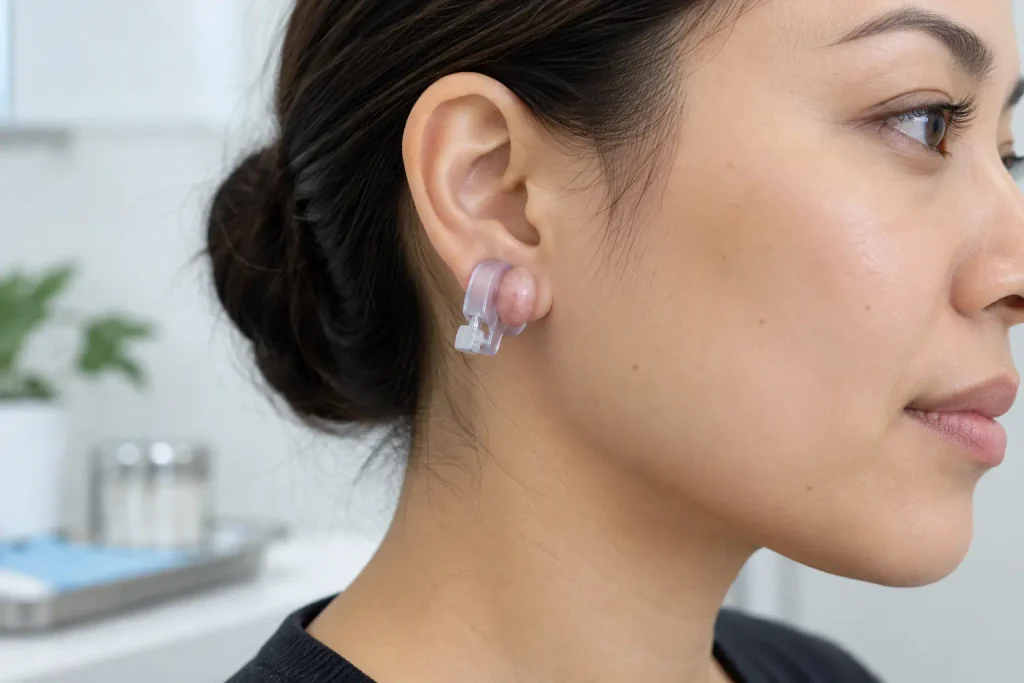
Pressure therapy uses fitted garments, clips, or earrings to apply sustained compression. It is particularly relevant after surgical removal of ear keloids.
A 2024 systematic review and meta-analysis supports compression earrings as a postoperative option, while noting differences between treatment protocols and the use of additional therapies in many studies.
Devices often need to be worn consistently for months. The pressure level and daily schedule should be selected by the treating clinician; there is no single setting suitable for every scar. Comfort, skin tolerance, and the ability to follow the schedule all matter.
For ear scars, see our guide to pressure therapy for ear keloids. Silicone sheets and compression devices are different treatments, although they may be used together.
Scar Revision and Postoperative Care
Scar revision describes an effort to improve a scar’s appearance or function rather than a separate treatment with guaranteed results. For keloids, the surgical plan should account for wound tension and recurrence.
The Nippon Medical School protocol described by Ogawa et al. (2021) includes tension-reducing surgical techniques, postoperative radiotherapy for surgically selected cases, and corticosteroid tape or plaster within its treatment algorithm.
This is a specialist protocol, not a requirement that every patient receive the same combination. Radiotherapy requires an individualized assessment of benefits and risks. Postoperative treatments also have different starting times, so patients should follow their surgical team’s instructions.
Laser Treatment
Laser treatment for keloid scars may be considered to address selected features such as redness, thickness, or reduced pliability.
The Cochrane review by Leszczynski et al. (2022) found low-certainty evidence that 585-nm pulsed-dye laser may improve hypertrophic and keloid scars compared with no treatment. Evidence for fractional CO₂ laser and several combination treatments was very uncertain.
The review did not establish that laser treatment, alone or in combination, consistently produces superior results. Ekstein et al. discuss lasers as potential adjuncts, including combinations with corticosteroid treatment.
Combination Therapies and Long-Term Results
Combining treatments is often considered because removing or flattening existing tissue does not eliminate the tendency to form another keloid.
Depending on the scar, a plan may include surgery followed by injections, compression, or selected postoperative radiotherapy. Silicone gel may also be discussed as part of scar care after healing. These options are covered in our broader keloid scar treatment guide.
The evidence supports individualized planning, rather than the claim that every combination outperforms every single treatment. Ekstein et al.
Setting Realistic Expectations
Before starting keloid removal treatment, discuss the expected improvement, recovery time, possible pigment changes, and follow-up schedule. Ask what the next step would be if the scar does not respond or begins growing again.
A successful outcome may mean a flatter, more comfortable, less noticeable scar rather than completely unmarked skin. If you are considering treatment, book a consultation to discuss your options and develop a plan suited to your scar and priorities.
Read Also / See Related
- Keloid scar treatment — Compare treatment options and the factors that guide an individual care plan.
- Keloids on the ear — Explore treatment considerations for piercing-related scars, including postoperative care and recurrence.
- Keloid steroid injections — Learn how injections may be used alongside other treatments to manage raised scar tissue.
References
- Limandjaja GC, Niessen FB, Scheper RJ, Gibbs S. The keloid disorder: heterogeneity, histopathology, mechanisms and models. Frontiers in Cell and Developmental Biology. 2020;8:360. Available at: https://pmc.ncbi.nlm.nih.gov/articles/PMC7264387/.
- Ekstein SF, Wyles SP, Moran SL, Meves A. Keloids: a review of therapeutic management. International Journal of Dermatology. 2021;60(6):661–671. doi: 10.1111/ijd.15159.
- Ren Y, Zhou X, Wei Z, et al. Efficacy and safety of triamcinolone acetonide alone and in combination with 5-fluorouracil for treating hypertrophic scars and keloids: a systematic review and meta-analysis. International Wound Journal. 2017;14:480–487. doi: 10.1111/iwj.12629.
- Searle T, Al-Niaimi F, Ali FR. 5-Fluorouracil in dermatology: the diverse uses beyond malignant and premalignant skin disease. 2021. Available at: https://pubmed.ncbi.nlm.nih.gov/33587385/.
- Compression therapy for keloid scars: a systematic review and meta-analysis. Plastic and Reconstructive Surgery – Global Open. 2024;12(6). doi: 10.1097/GOX.0000000000005864.
- Ogawa R, Dohi T, Tosa M, Aoki M, Akaishi S. The latest strategy for keloid and hypertrophic scar prevention and treatment: The Nippon Medical School (NMS) protocol. Journal of Nippon Medical School. 2021;88(1):2–9. doi: 10.1272/jnms.JNMS.2021_88-106.
- Leszczynski R, da Silva CAP, Pinto ACPN, Kuczynski U, da Silva EMK. Laser therapy for treating hypertrophic and keloid scars. Cochrane Database of Systematic Reviews. 2022;9. doi: 10.1002/14651858.CD011642.pub2.
Medical disclaimer
The information in this article is provided for general educational purposes and does not replace professional medical advice, diagnosis, or treatment. Consult a dermatologist or another qualified healthcare professional about your symptoms and treatment options. Do not disregard professional medical advice or delay seeking care because of information you have read on KeloidCare.org. Responses to keloid treatments vary, and individual results cannot be guaranteed.