

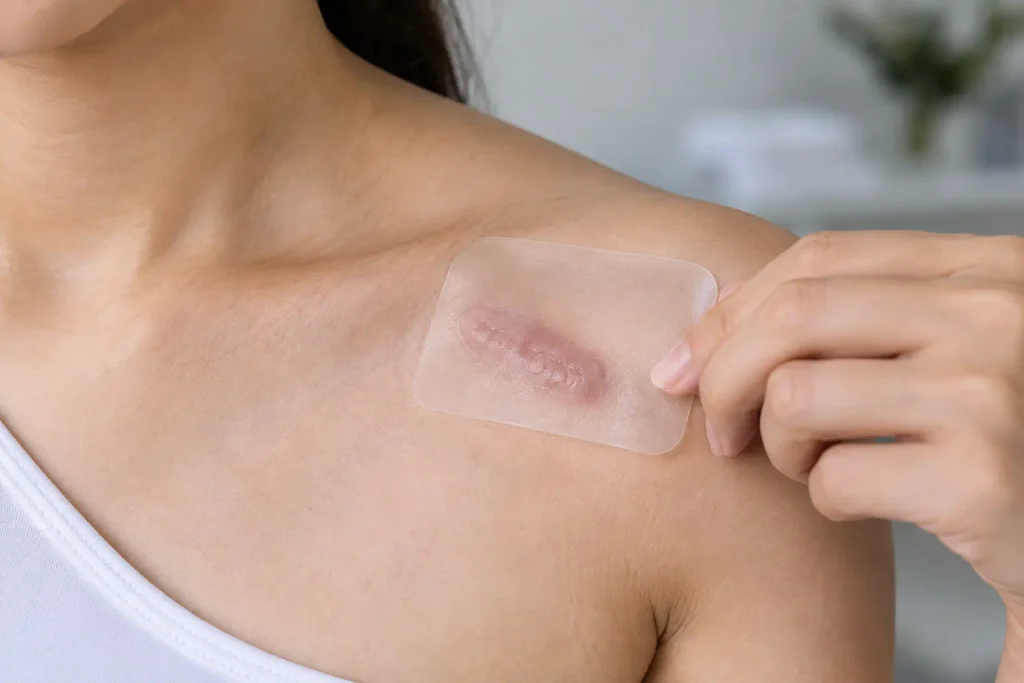
Silicone gel sheets for keloids are a non-invasive scar-care option that dermatologists may recommend as part of a treatment plan. These flexible coverings may help flatten some raised scars, but they should not be presented as a guaranteed way to remove a keloid.
Understanding their limitations is just as important as knowing how to apply them. This guide explains the available evidence, practical differences between sheets and gels, and questions to discuss with your dermatologist before starting treatment.
Understanding Keloids and Their Challenges
Keloids are raised scars that grow beyond the boundaries of the original skin injury. They can cause itching, tenderness, and other keloid symptoms, as well as concerns about appearance. Unlike a scar that stays within the original wound, a keloid can continue expanding into nearby skin.
Treatment depends on the scar’s size, location, symptoms, and response to previous therapies. The American Academy of Dermatology’s overview of keloid scars explains why an individual assessment matters. Our guide to keloid scar treatment introduces the wider range of available options.
How Do Silicone Gel Sheets for Keloids Work?
Silicone sheets form a protective layer over healed skin and help maintain hydration. Their exact effect on scar development is not fully understood, so claims that they directly stop collagen production or rapidly remodel a keloid should be treated cautiously.
Silicone sheeting is also different from pressure therapy. Although a sheet rests against the skin, it does not replace a prescribed compression device. Great Ormond Street Hospital’s scar-care guidance describes silicone as a barrier that helps retain moisture in healing scar tissue.
Do Silicone Gel Sheets for Keloids Work?
Clinical use is common, but research specifically examining established keloids remains limited. A 2023 Cochrane review identified two small randomized studies and rated the evidence as very low certainty.
The review could not establish whether silicone sheeting improves keloid severity more than no treatment, non-silicone dressings, or injections of triamcinolone. This uncertainty does not prove that silicone never helps; it means that reliable conclusions about its effectiveness are still difficult to draw.
For someone considering silicone gel sheets for keloids, the practical message is to set realistic goals. Discuss whether the aim is symptom management, a possible change in scar appearance, or support after another procedure. Complete disappearance should not be promised.
How to Apply Silicone Sheets Safely
Start only after the skin has fully healed. The American Academy of Dermatology advises against applying silicone sheets to open wounds or scabs.
Follow the instructions for the specific product:
- Clean and dry the scar and surrounding skin.
- Apply the sheet according to the manufacturer’s directions.
- Build up wear time if advised, rather than starting with prolonged use immediately.
- Clean reusable sheets as directed.
- Replace the sheet when it deteriorates or when the product instructions recommend replacement.
If redness or irritation develops, remove the sheet and allow the skin to recover. Persistent or recurring symptoms should be discussed with your clinician. Chelsea and Westminster Hospital’s guidance provides practical instructions on application, cleaning, and skin tolerance.
How Long Should You Wear Silicone Sheets?
There is no single schedule suitable for every product and every person. Daily wear time should follow the product instructions and your clinician’s advice.
Chelsea and Westminster Hospital recommends an initial treatment period of approximately 90 days in its scar-care guidance, with longer use in some cases. This is a review point rather than a guaranteed deadline for improvement. Ask when your scar should be reassessed and what changes would justify continuing treatment.
Silicone Sheets vs. Silicone Gel
Topical silicone gel for keloids offers another way to apply silicone to a healed scar. It may be more practical where a sheet is difficult to position, including the face or areas around moving joints. Guy’s and St Thomas’ NHS guidance discusses these uses.
When comparing formats, consider:
- Whether the product stays in place during everyday activities.
- How easily you can follow the application and cleaning instructions.
- Whether your skin tolerates the product.
- The ongoing cost of replacement.
Convenience can help you follow a treatment routine, but it does not establish that one format will produce better results for your keloid.
Why Treatment May Include More Than Silicone
Keloids can return after treatment, particularly after surgery alone. Depending on the individual case, a dermatologist may combine approaches such as corticosteroid injections, surgery, cryotherapy, or pressure therapy. Laser treatment for keloid scars may also be considered in selected cases. Silicone sheets may be included after another treatment.
The American Academy of Dermatology’s treatment guidance describes several combinations. There is no universal combination or recurrence rate that applies to every keloid. For scars on the ear, our guide to pressure therapy for ear keloids covers a related treatment option.
Choosing a Silicone Scar Product
When comparing silicone gel sheets for keloids, look for clear labeling, application instructions, cleaning guidance, and replacement information. Choose a size and format that suit the scar’s location and your routine.
Treat testimonials as personal experiences rather than proof of effectiveness. Ask your dermatologist to help evaluate products if the claims are unclear, particularly when a product promises permanent removal or unusually rapid results.
Frequently Asked Questions
Can Silicone Sheets Remove an Old Keloid?
Removal cannot be guaranteed. Evidence for treating established keloids is uncertain, and an older scar may need assessment for other options. Agree on realistic treatment goals with your dermatologist.
Can I Use Them After Keloid Surgery?
They may be included in postoperative care, but only once the wound has healed and your treating clinician confirms when to begin.
How Can I Track Changes?
Consider taking photographs under similar lighting and noting changes in comfort, appearance, and skin tolerance. Bring these observations to follow-up appointments so you can discuss whether the treatment remains appropriate.
Read Also / See Related
- Newly formed keloid scars — Explore early assessment and where silicone-based care may fit into a treatment plan.
- Keloid steroid injections — Learn about an option your clinician may discuss when a raised scar needs additional treatment.
- Keloid vs. hypertrophic scar — Understand why evidence about silicone treatment can differ between these two scar types.
References
- American Academy of Dermatology Association. Keloid scars: Overview. Available at: https://www.aad.org/public/diseases/a-z/keloids-overview.
- Great Ormond Street Hospital for Children NHS Foundation Trust. How do I take care of my scars after surgery? Available at: https://www.gosh.nhs.uk/conditions-and-treatments/procedures-and-treatments/how-do-i-take-care-of-my-scars-after-surgery/.
- Tian F, Jiang Q, Chen J, Liu Z. Silicone gel sheeting for treating keloid scars. Cochrane Database of Systematic Reviews. 2023;1. doi: 10.1002/14651858.CD013878.pub2.
- American Academy of Dermatology Association. Keloid scars: Diagnosis and treatment. Available at: https://www.aad.org/public/diseases/a-z/keloids-treatment.
- Chelsea and Westminster Hospital NHS Foundation Trust. Silicone gel sheets. Available at: https://www.chelwest.nhs.uk/your-visit/patient-leaflets/burns/silicone-gel-sheet.
- Guy’s and St Thomas’ NHS Foundation Trust. Scar care for hand injuries. Available at: https://www.guysandstthomas.nhs.uk/health-information/scar-care-hand-injuries.
Medical disclaimer
The information in this article is provided for general educational purposes and does not replace professional medical advice, diagnosis, or treatment. Consult a dermatologist or another qualified healthcare professional about your symptoms and treatment options. Do not disregard professional medical advice or delay seeking care because of information you have read on KeloidCare.org. Responses to keloid treatments vary, and individual results cannot be guaranteed.
[…] Silicone Gel & Sheets […]
[…] Silicone Gel & Sheets […]